Breed guide · By Curious Tails · Updated Jul 2026
What Is a Pomeranian? The Complete Breed Guide
The bold little watchdog with a showpiece coat. Here is the honest, Singapore-specific guide to the Pomeranian: size, coat, colours, temperament, barking, health and what life with one is really like in an HDB flat.
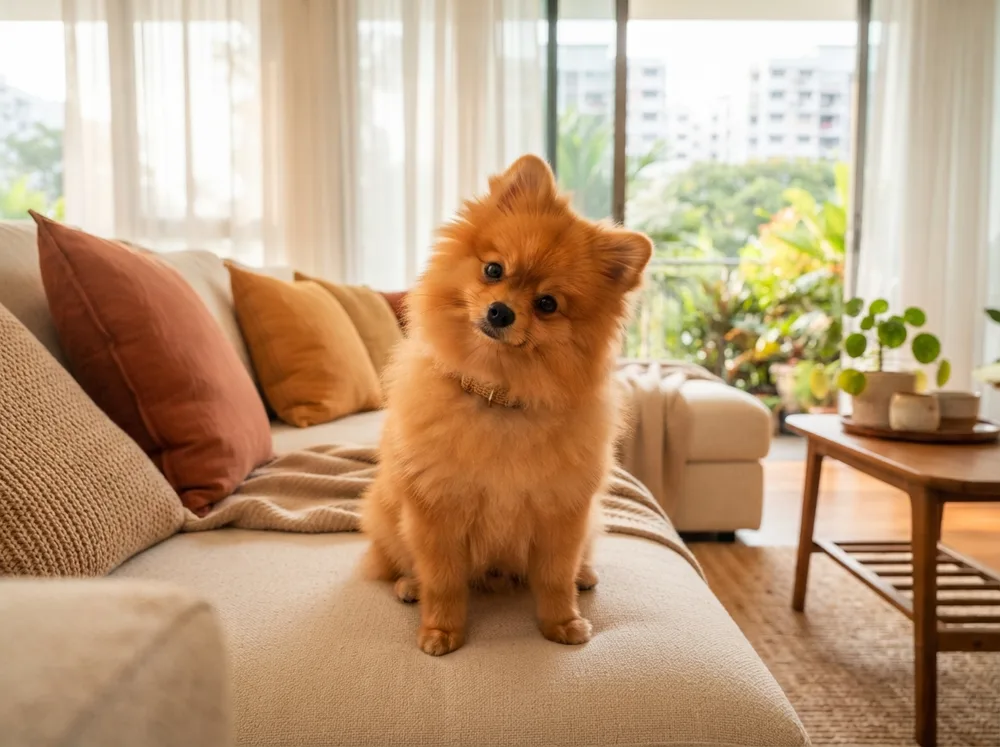
Pomeranian puppies
From $4,288, all-in
What is a Pomeranian?
A Pomeranian is a toy-size spitz dog: a compact, fox-faced companion with a thick double coat and a famously bold personality. Weighing about 1.9 to 3.5 kg full grown, it descends from larger northern sled dogs and was bred down to lap size in 19th-century Europe. Poms are alert, affectionate and highly trainable, which makes them spirited little watchdogs rather than quiet lapdogs.
1.9–3.5 kg
Adult weight (standard)
12–16 yrs
Commonly cited lifespan
HDB ✓
On the approved list
$4,288
All-in, from
Your guide to every Pomeranian question
This page is the map. Each card opens a full guide, written from what we actually see placing Pomeranians with Singapore families.
Temperament
Bold, alert, big personality in a tiny body.Full-grown size
How big they really get: 1.9 to 3.5 kg.Colours
Orange, sable, cream, parti and more.Coat & shedding
The double coat and the seasonal blow.Grooming
Teddy trims, and why you never shave.Barking
Why they bark and how to manage it.Health & lifespan
12 to 16 years, and what to watch.Training
Toilet, bark and manners for first-timers.Price
What they cost in Singapore. From $4,288, all-in.HDB rules
Yes, approved. Here is the proof.Teacup truth
What that word really means.Compare breeds
Pomeranian vs the other small breeds.Where the Pomeranian comes from
The Pomeranian takes its name from Pomerania, the region straddling modern-day northern Poland and Germany. Its ancestors were much larger spitz-type working dogs of the far north, the same family that gives us the Keeshond and the German Spitz. Over the 1800s the breed was selectively made smaller and fluffier, and it became a European sensation after Queen Victoria fell for a small orange Pom and bred toward the compact size we know today.
So a Pomeranian is a purebred toy spitz with a big-dog heritage packed into a 2 to 3 kg frame. That history explains a lot about the dog in your flat: the dense weather-proof coat, the confident alert bark, and the surprising hardiness behind the fluff.
Pomeranian at a glance
- Type: purebred toy spitz
- Adult weight: 1.9 to 3.5 kg
- Height: about 18 to 24 cm
- Coat: dense double coat, heavy seasonal shed
- Energy: lively but small, flat-friendly
- Lifespan: commonly cited 12 to 16 years
Temperament: a bold little watchdog
Do not let the pom-pom look fool you. Pomeranians are confident, curious and self-assured, with far more personality than their size suggests. They bond closely with their people, love to be involved in whatever the household is doing, and are quick, eager learners thanks to that clever spitz brain.
The flip side of all that alertness is that a Pom will tell you when something is happening at the door. This makes them excellent little watchdogs and a genuinely poor fit for anyone wanting a silent, switched-off lapdog. Read the full Pomeranian temperament breakdown for what they are like to live with day to day.
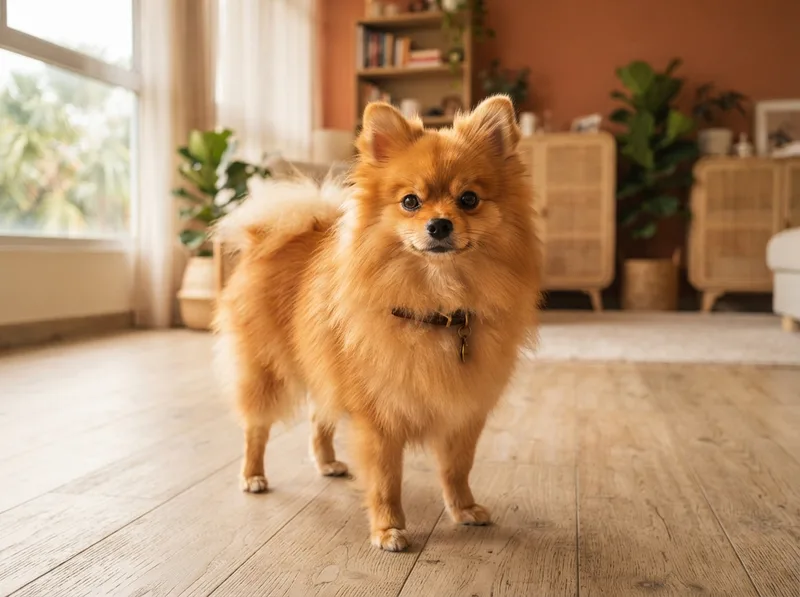
Do Pomeranians bark a lot?
Honestly, they can. Poms are alert by nature and will sound the alarm at corridor noise, the lift and the doorbell. That instinct is trainable, not a life sentence: with early, consistent bark training and enough mental stimulation, most Pomeranians settle into calm flat dogs that only speak up when it matters. Our guide to how vocal Pomeranians really are covers exactly how to manage it in an HDB block.
How big does a Pomeranian get?
A standard, healthy Pomeranian weighs about 1.9 to 3.5 kg full grown and stands roughly 18 to 24 cm at the shoulder. Most reach their adult size by nine to twelve months, filling out their coat a little later. The Poodle-cross size games you see in other breeds do not apply here: a Pomeranian is a Pomeranian, and a well-bred one lands in that standard band.
You will still see dogs advertised as "teacup" Pomeranians. There is no recognised teacup size, and the term usually describes deliberately undersized dogs that carry real health risks. We place standard, healthy Pomeranians only. Our honest teacup Pomeranian guide and the full size and growth chart explain why.
Size, honestly
- Standard adult: 1.9 to 3.5 kg
- Shoulder height: about 18 to 24 cm
- Adult size by roughly 9 to 12 months
- "Teacup" is a marketing word, not a size
- We place standard, healthy Poms only
The coat: colours, shedding and the puppy uglies
The Pomeranian has the widest colour range of any small breed we place: iconic orange, sable, cream, white, parti, chocolate, black and tan, and black, with rarer shades covered on the colours guide. Whatever the shade, the coat is a true double coat, a soft dense undercoat under longer stand-off guard hairs, which is what gives the Pom its round, fluffy silhouette.
That coat sheds. Expect steady day-to-day shedding plus a heavier seasonal "coat blow" once or twice a year. There is also a normal adolescent stage, affectionately called the "puppy uglies", where a young Pom looks thin and patchy for a few months before the adult coat comes in. It is not a defect, and it is not a reason to panic-shave. See the shedding and coat-blow guide for the brushing routine that keeps it all under control.
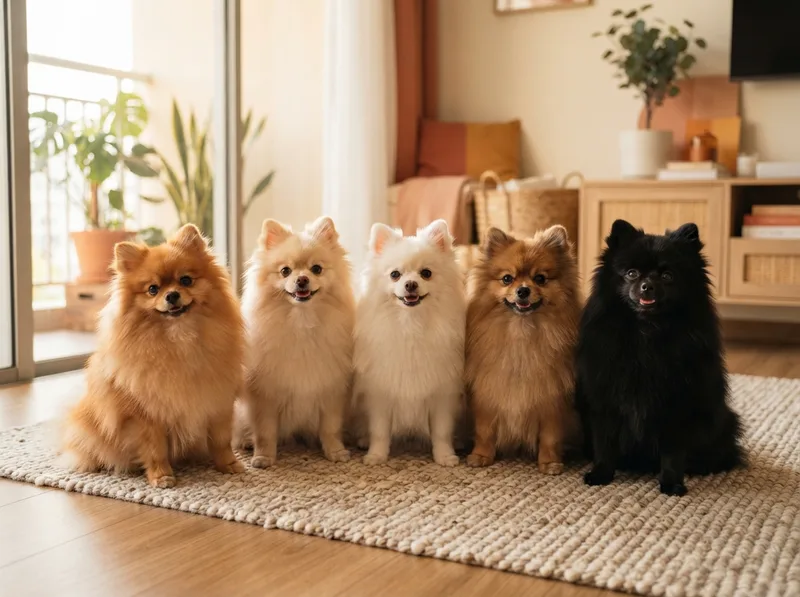
Grooming: never shave a Pomeranian
Grooming a Pom is real, recurring work: brush several times a week, more during a coat blow, plus a tidy professional trim every few weeks if you like the teddy-bear look. What you should never do is shave a Pomeranian down to the skin. The double coat does not reliably grow back the same, and clipping it away removes the insulation that actually helps the dog cope with Singapore heat, while exposing skin to sunburn.
A "boo" or teddy-bear trim is a tidy-up of the coat, not a shave. Our guide to grooming a double coat covers salon cadence, the tools that work in humidity, and the heat myth in full.
Coat care rules
- Brush several times a week
- Expect a heavy coat blow once or twice a year
- Teddy and boo trims are fine
- Never shave to the skin
- Puppy uglies (about 4 to 8 months) are normal
How long do Pomeranians live? Health in brief
Pomeranians are a long-lived breed, commonly cited at 12 to 16 years. Like every small breed they carry a few things to watch, and knowing them is how you keep a Pom healthy, not a reason to worry. The main ones are luxating patella (slipping kneecaps), tracheal collapse, dental disease in that small mouth, juvenile hypoglycaemia in very young or very tiny pups, and a coat condition called alopecia X, sometimes called black skin disease.
Two practical takeaways: walk a Pom on a harness, never a neck collar, to protect the windpipe, and buy from a licensed source that vaccinates and health-checks. Our puppies follow a vaccination schedule of weeks 6, 8 and 12 with an optional booster at 16, are dewormed at each visit, and go home at around nine weeks. The full health and lifespan guide goes deeper on each condition.
What to watch
- Luxating patella (knees)
- Tracheal collapse: use a harness
- Dental disease: small mouth
- Hypoglycaemia in very tiny pups
- Alopecia X / black skin disease
- Vaccinations weeks 6 / 8 / 12
Not sure a Pomeranian fits your home and routine? Tell us about your flat and your days, and we will tell you honestly.
Ask on WhatsAppLiving with a Pomeranian in Singapore
This is where a Pomeranian really shines, and where overseas breed guides go quiet. The Pom is named on HDB’s approved small-breed list, so unlike many crossbreeds the approval question is a clean yes. You may keep one approved dog per flat, every dog needs an annual AVS licence, and first-time owners take a short pet ownership course. A small dog suits flat living, and a Pom’s exercise needs are modest: a couple of short walks plus indoor play.
The tropical catch is that thick arctic coat. Poms handle Singapore fine with sensible care: walk in the cooler early morning and evening, keep them in air-conditioning or shade through the midday heat, and never shave the coat in a misguided attempt to cool them down. Our blog on keeping a Pomeranian cool in Singapore covers the heat routine in detail.
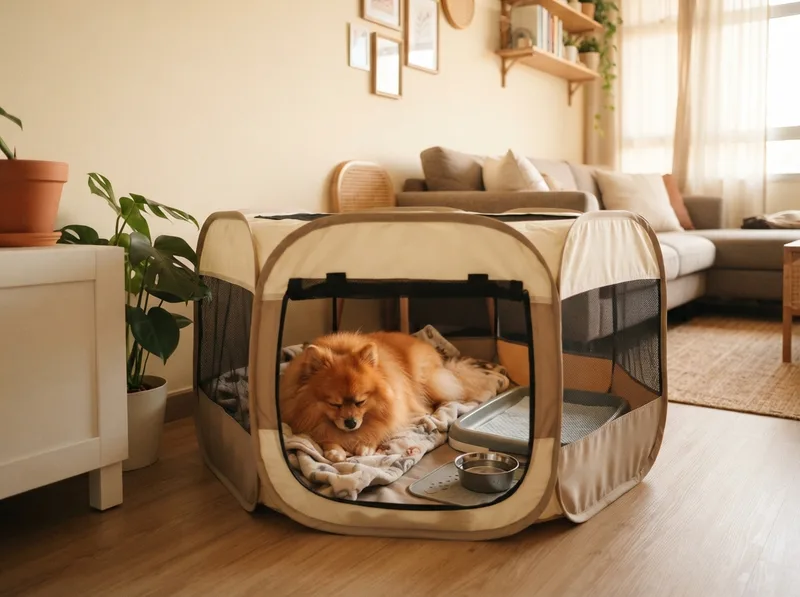
Training a Pomeranian
Pomeranians are clever and eager, which makes them very trainable, but that same intelligence means a bored or under-stimulated Pom will invent its own entertainment. Start early with toilet training, calm handling and gentle socialisation, and put real work into bark control from day one, since it is far easier to shape than to undo. Positive, reward-based training suits the breed best.
Every puppy we place comes with a free first training lesson with a certified trainer to get you started on the right foot. Our guide to how Pomeranians learn walks through toilet training in a flat, bark work and socialisation.
First-timer priorities
- Toilet training on pads and schedule
- Bark control from day one
- Early, gentle socialisation
- Reward-based methods only
- Free first training lesson included
The honest downsides
A guide that only lists the good bits is a sales pitch, not the truth. Here is what Pomeranian owners most often wish they had known. They are vocal, and barking needs managing in a shared HDB block. The coat is ongoing work and a real recurring grooming cost. They go through the awkward "puppy uglies" stage that catches new owners off guard. And a bold small dog with no boundaries can develop "small-dog syndrome", so calm, consistent leadership matters.
None of these are dealbreakers for the right owner, and every one is manageable with training and care. They are simply the honest trade for one of the most characterful, striking small dogs you can own.
Know before you commit
- Vocal: bark training is not optional
- Coat: regular brushing and grooming cost
- Puppy uglies stage looks alarming (it is normal)
- Needs calm, consistent boundaries
- Not the dog for silence-seekers
How does a Pomeranian compare with other small breeds?
Buyers cross-shopping small breeds usually weigh the Pom against the other compact dogs common in Singapore. In short: a Pomeranian is bolder and more vocal than a Maltese or Shih Tzu, fluffier and more double-coated than a smooth Chihuahua, and, despite the size confusion, a very different, much smaller dog than a Japanese Spitz.
If you want the softer, quieter, velcro-lapdog end of the spectrum, a Pom may not be your match, and that is fine. Our side-by-side comparison hub lines the Pomeranian up against the Chihuahua, Maltese, Shih Tzu and Japanese Spitz so you can choose honestly.
Quick contrasts
- Bolder and more vocal than a Maltese
- Fluffier than a smooth Chihuahua
- Higher grooming than a Shih Tzu
- Much smaller than a Japanese Spitz
- A watchdog, not a silent lapdog
Who a Pomeranian is not for
We would rather talk you out of the wrong breed than sell you the wrong dog. A Pomeranian is probably not for you if you need a silent dog for a noise-sensitive block and will not do bark training, if you have zero time or budget for regular coat care, or if you want a rugged jogging companion. It is also not the pick if you specifically want a calm, quiet, low-energy lapdog, the sister breeds we place suit that better.
A Pomeranian is a wonderful fit if you want a small, striking, HDB-friendly dog with a huge personality, you will invest in coat care and basic bark training, and you want a spirited companion that is genuinely interested in your day. If that is you, this is a fantastic breed.
Getting a Pomeranian in Singapore, safely
Buy only from an AVS licensed source and verify it yourself. Unlicensed listings on classifieds and chat groups are where sick, poorly bred and smuggled puppies change hands. A licensed shop means vaccinations, health checks, microchipping and the licensing paperwork are all handled properly.
Pomeranian.sg is a Pomeranian specialist run by Curious Tails, an AVS licensed pet shop (licence AS24J00046). We have placed 30+ Pomeranians with Singapore families. Our pricing is $4,288–$4,888 all in, and we lead with "From $4,288, all-in". That includes the 30-item starter kit, free home delivery and playpen setup, the first training lesson, and licensing handled at the shop. Puppies go home at around nine weeks after their second vaccination.
What all-in includes
- From $4,288, all in (range $4,288 to $4,888)
- 30-item starter kit worth $500+
- Free home delivery and playpen setup
- Free first training lesson
- Vaccinations, deworming and microchip
- AVS licensing handled at purchase
- Verify licence AS24J00046 on the AVS registry
Prefer to check for yourself first? Here is the AVS public registry of licensed pet shops.Pomeranian.sg holds 45 Google reviews at a 5.0 rating throughCurious Tails.
Are Pomeranians hypoallergenic?
No. The Pomeranian is not a hypoallergenic breed, and Google's own breed panel says so directly. Allergic reactions are triggered by proteins in dander, saliva and urine rather than by hair itself, so no dog is truly hypoallergenic. What varies is how much of that material a breed distributes around your flat, and a shedding double coat distributes a lot of it.
If someone in the household has a diagnosed dog allergy, this is a genuine reason to choose a different breed rather than a problem to manage with air purifiers. If the sensitivity is mild, the practical levers are frequent brushing done outside or on a balcony, washing bedding weekly, keeping the dog off the bed, and vacuuming more than you think you need to. Be honest with yourself before the puppy arrives, not after.
Allergy reality check
- Not a hypoallergenic breed
- Dander and saliva carry the allergens
- A double coat spreads more of both
- Brushing outside helps, it does not fix
- Diagnosed allergy: choose another breed
Teacup, mini and throwback: the size labels explained
Three size labels circulate around this breed and none of them is a real category. Teacup and mini are sales words describing dogs bred or marketed below the standard 1.9 to 3.5 kg. They are not recognised by any kennel club, and dogs at that extreme carry higher risks of fragile bones, dental crowding and juvenile hypoglycaemia. In Singapore listings the word usually arrives attached to a higher price, which tells you what it is really for.
Throwback runs in the opposite direction. It describes an oversized Pomeranian of roughly 4 to 6 kg that looks closer to the breed's German Spitz ancestors. Throwbacks are generally healthy dogs and there is nothing wrong with owning one, but they are outside the breed standard and they are not what we place. We place standard Pomeranians, which means the dog you meet at eight weeks grows into the dog described everywhere else on this page. The full-grown Pomeranian size guide has the growth chart if you want to check a puppy against it.
Three labels, decoded
- Teacup: marketing, not a size
- Mini: the same word wearing a different hat
- Throwback: oversized, roughly 4 to 6 kg
- Standard: 1.9 to 3.5 kg, 18 to 24 cm
- We place standard Pomeranians only
Frequently asked questions
Is a Pomeranian a good first dog in Singapore?
Yes, for the right home. A Pomeranian is small, HDB approved and thrives in a flat, but it is alert and vocal, and the double coat needs regular brushing. If you want a characterful small dog and will do bark training and coat care, it is a strong first dog. If you want a silent, wash-and-go lapdog, look at a softer breed instead.
Are Pomeranians allowed in HDB flats?
Yes. The Pomeranian is named on HDB’s approved small-breed list, so it is one of the cleanest yes answers of any breed. You may keep one approved dog per flat, and every dog needs an annual AVS licence. First-time owners should also do the free AVS pet ownership course.
Do Pomeranians bark a lot?
They can. Poms are alert little watchdogs and will sound off at the corridor, the lift and the doorbell. The good news is that barking is trainable: with early, consistent work and enough mental stimulation, most settle into quiet flat dogs that only alert when it matters.
How big does a Pomeranian get?
A standard Pomeranian weighs about 1.9 to 3.5 kg full grown and stands around 18 to 24 cm at the shoulder. They reach adult size by roughly 9 to 12 months. We place standard, healthy Pomeranians only, not undersized dogs marketed as "teacup".
Do Pomeranians shed?
Yes. The double coat sheds steadily and blows out heavily once or twice a year. Brushing a few times a week keeps loose hair and mats under control, and there is a normal adolescent thinning stage called the "puppy uglies" that grows back into the full adult coat.
What is a Pomeranian called in Chinese?
In Singapore you will most often see the Pomeranian written as 博美犬 (bó měi quǎ), and sometimes as 英国精靈 or simply "Pom". They are all the same toy spitz breed described on this page.
When can a Pomeranian puppy come home?
Our Pomeranian puppies go home at around nine weeks, after their second vaccination. Vaccinations run at weeks 6, 8 and 12 with an optional booster at 16, deworming at each visit, and an annual booster from year one. Licensing paperwork is handled for you at purchase.
How much is a Pomeranian in Singapore?
Our Pomeranians are $4,288–$4,888 all in, and we lead with "From $4,288, all-in". That figure includes the starter kit, home delivery and playpen setup, the first training lesson and licensing handled at the shop. The wider Singapore market runs from around $3,000 to $6,800.
Meet your Pomeranian
Come say hello at Balestier
2 Balestier Road #01-701, Singapore 320002 · Weekdays 12pm–6pm · Weekends 10am–6pm. Or message us first: tell us about your home and routine, and we'll tell you honestly if a Pomeranian fits.
Read the price guide next
Every dollar of the all-in price explained, plus the yearly cost of owning a Pom.
See the price guide