Coat guide · By Curious Tails · Updated Jul 2026
Do Pomeranians Shed? The Double Coat Explained
Yes, Pomeranians shed, and there is a big seasonal coat blow to plan for. Here is the honest guide to the double coat, the brushing routine that keeps it under control, and coping with it all in Singapore's heat.
Pomeranian puppies
From $4,288, all-in
Do Pomeranians shed a lot?
Yes. Pomeranians have a thick double coat that sheds steadily all year and blows out heavily once or twice a year. They are not a low-shedding or hypoallergenic breed. Brushing several times a week keeps loose hair and matting under control, and the heavier seasonal coat blow, while dramatic, is temporary and clears quickly with daily brushing.
Yes
They shed year-round
Double coat
Undercoat plus guard hairs
1–2×/yr
Heavy seasonal coat blow
3–4×/wk
Brushing to stay ahead
The double coat, explained
A Pomeranian's fluff is not one coat but two. Underneath sits a soft, dense undercoat that acts as insulation, and over it stand longer, straight guard hairs that form the round, stand-off silhouette and the showpiece ruff around the neck. That structure is pure spitz, inherited from the breed's cold-climate ancestors, and it is the whole reason a Pom looks like a little cloud.
Both layers shed. The guard hairs release gradually, while the undercoat is what you see come out in tufts, especially during a coat blow. Understanding that you are managing two coats, not one, is the key to keeping a Pom comfortable and tidy. Whatever the colour, the coat works the same way, as covered in our Pomeranian colours guide.
Two coats in one
- Soft dense undercoat for insulation
- Long guard hairs for the fluffy shape
- Both layers shed year-round
- Undercoat sheds most in a coat blow
- Not hypoallergenic or low-shedding
Everyday shedding vs the seasonal coat blow
Day to day, a Pomeranian sheds a modest, steady amount of hair, the loose fluff you will find on the sofa and your clothes. This baseline shedding is easily managed with regular brushing and is nothing dramatic. It is the normal cost of living with a fluffy double-coated dog, and far less than many people fear once a routine is in place.
Then, once or twice a year, comes the coat blow. Over a few weeks the dog drops a large volume of dead undercoat, and the shedding jumps sharply. It looks alarming the first time, but it is completely normal and temporary. Daily brushing through a coat blow clears the loose undercoat fast, prevents matting, and gets you both to the other side with the coat healthier for it.
Two kinds of shedding
- Steady, light shedding all year
- Easily managed with routine brushing
- A heavy coat blow once or twice a year
- Weeks of extra undercoat loss
- Normal, temporary, and clears with daily brushing
How often to brush a Pomeranian
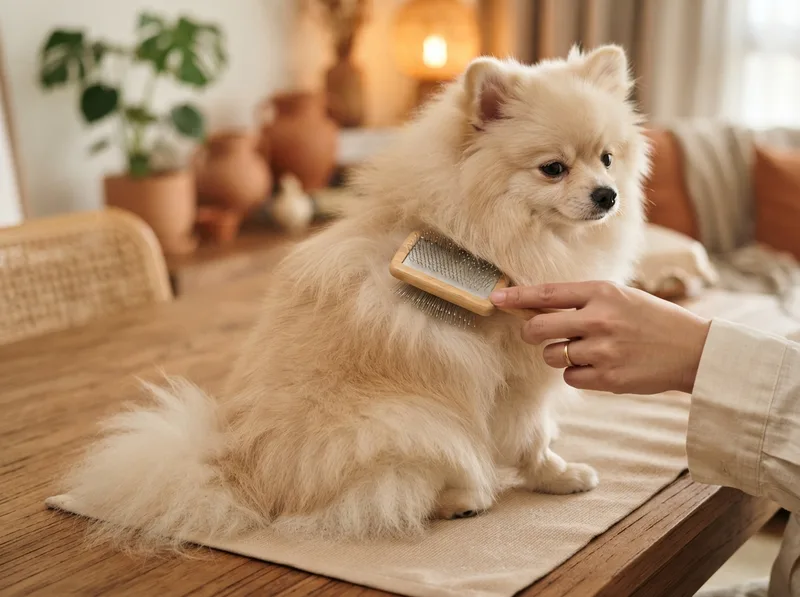
As a baseline, brush a Pomeranian several times a week, and step up to daily during a coat blow. The goal is to remove loose hair before it can tangle, spread the natural oils through the coat, and reach the skin. The technique that actually works is line brushing: lifting the coat and brushing in sections down to the skin, rather than skimming over the surface where hidden mats form unseen.
A slicker brush and a metal comb are the core tools, and a comb is the honest test, if it runs cleanly to the skin, the coat is truly mat-free. Regular brushing at home also keeps professional grooming shorter and easier. Our full Pomeranian grooming guide covers the tools that work in humidity, salon cadence, and why you never shave the coat.
Brushing routine
- Several times a week as a baseline
- Daily during a coat blow
- Line-brush down to the skin
- Slicker brush plus a metal comb
- A clean comb-through means mat-free
Shedding and the double coat in Singapore's heat
An arctic-origin coat in the tropics worries a lot of new owners, but the honest answer is that the double coat helps a Pom cope with heat, it does not cause overheating on its own. It insulates against heat as well as cold, which is exactly why you never shave it to cool the dog down. Keep the coat brushed out and free of matting so air can move through it, walk in the cooler early morning and evening, and use shade and air-conditioning through the midday heat. Our blog on keeping a Pomeranian cool in Singapore covers the full heat routine.
The puppy uglies: a normal shedding stage
Somewhere around four to eight months, many Pomeranians go through a stage owners affectionately call the "puppy uglies". The soft puppy coat drops out before the full adult coat has grown in, and for a few weeks or months the dog can look thin, patchy and distinctly un-fluffy. It is one of the most common panics we hear from new owners, and it is almost always completely normal.
This is not a defect, not a health problem, and absolutely not a reason to shave. Keep brushing gently, feed well, and let nature run its course, the adult coat comes in and the showpiece fluff returns. If the skin itself looks bare or darkened rather than just thin, that is worth a vet check for an unrelated condition. Our blog on the puppy uglies explains the timeline and how to tell normal from not.
Puppy uglies at a glance
- Usually around 4 to 8 months
- Puppy coat drops before the adult coat
- Looks thin and patchy for weeks
- Normal, not a defect
- Never a reason to shave
- Bare or dark skin, though, means a vet check
Wondering whether you can keep up with the coat? Tell us about your routine and we will be honest about what Pomeranian coat care really takes.
Ask on WhatsAppWhy coat blow works differently in Singapore
Search whether Pomeranians shed and every answer you will find says the coat blows twice a year, in spring and autumn. Singapore has neither. The two cues that drive a seasonal coat change are day length and sustained temperature swing, and here the day length barely moves across the year while the temperature sits between roughly 26 and 32 degrees regardless of the month.
What we see across the Pomeranians we have placed is a coat that releases undercoat more evenly through the year instead of dumping it in two dramatic weeks. Air conditioning muddies it further, because a dog moving between a cooled flat and an outdoor corridor is getting mixed signals rather than a clean seasonal one. This is our own observation rather than a published study, so treat it as what a Singapore owner should expect rather than a law.
The practical consequence is good news. You are less likely to face a fortnight of chaos and more likely to face a steady, manageable trickle, which a fixed brushing schedule handles easily. The mistake is assuming that because there is no dramatic blow, the coat does not need work. It does, just spread out.
Tropical coat, in short
- No spring or autumn trigger here
- Undercoat releases more evenly year-round
- Air conditioning blurs the signal further
- Less drama, more constant maintenance
- Fixed schedule beats reacting to the mess
When shedding is not normal
Normal shedding thins a coat. It does not clear it. The line that matters, and the one experienced owners repeat to every panicking newcomer, is that you should not see bare skin at any stage of the puppy uglies. A thin, uneven, slightly ridiculous adolescent coat is normal. Skin showing through in patches is not, and it is the point at which this stops being a grooming question.
The pattern worth recognising is symmetrical loss over the body and back of the thighs while the head and front legs keep their coat, sometimes with the exposed skin darkening. That picture is consistent with alopecia X, also called black skin disease, which is genuinely associated with this breed. It needs a vet, not a different shampoo. Alopecia X and black skin disease goes through what the diagnosis involves, and the puppy uglies explained covers the normal version you are probably looking at.
Normal or not
- Normal: thin, uneven, fluffy, scruffy
- Normal: heavier loss around 4 to 8 months
- Normal: more hair on the sofa in some months
- Not normal: visible bare skin
- Not normal: symmetrical patches, darkened skin
- Not normal: itching, redness or scabs
- Any of the last three: see a vet
Living with the hair
Honest answer: you will find Pomeranian hair in places you did not know the dog went. Guard hairs are long and visible on dark fabric, and undercoat is fine and drifts. A shedding double coat in a three-room flat is a real, recurring household task, and anyone telling you a brush solves it entirely has not lived with one.
What genuinely helps is doing the work outside the flat where possible, brushing on a balcony or in a service yard so the loose coat never enters the room. Beyond that: a vacuum you can grab in thirty seconds rather than one you have to assemble, washable throws on the sofa, and a rubber glove or squeegee for fabric, which lifts embedded hair far better than a lint roller. Pomeranians are not hypoallergenic, so if someone in the household has a diagnosed dog allergy, this is a reason to choose a different breed rather than a cleaning problem to solve. Otherwise it is twenty minutes a week, and our Pomeranian puppies come with the coat advice built in.
Frequently asked questions
Do Pomeranians shed a lot?
Yes. Pomeranians have a double coat that sheds steadily all year and blows out heavily once or twice a year. They are not a low-shedding or hypoallergenic breed. Brushing several times a week keeps loose hair and matting under control, and the seasonal coat blow is heavier but temporary.
What is a coat blow in a Pomeranian?
A coat blow is the heavy seasonal shed when a Pomeranian drops a large amount of undercoat over a few weeks, usually once or twice a year. You will see far more loose fluff than normal. Daily brushing during this period clears the dead undercoat quickly and prevents mats, and it passes on its own.
How often should I brush a Pomeranian?
Brush a Pomeranian several times a week as a baseline, and daily during a coat blow. Regular brushing removes loose hair before it mats, spreads coat oils, and keeps the double coat healthy. A line-brushing technique down to the skin, not just over the surface, is what actually prevents hidden matting.
Are Pomeranians hypoallergenic?
No. Pomeranians are a double-coated shedding breed and are not hypoallergenic. They release loose hair and dander year-round, with heavier shedding during seasonal coat blows. If allergies are a concern, a Pomeranian is not the low-shedding breed to choose, and honest advice matters more than a sale here.
Why does my Pomeranian puppy look thin and patchy?
That is almost certainly the "puppy uglies", a normal adolescent stage around four to eight months when the puppy coat drops before the full adult coat grows in. It looks alarming but it is not a defect and it is not a reason to shave. The adult coat fills in and the fluff returns.
Does shaving reduce Pomeranian shedding?
No, and you should never shave a Pomeranian to manage shedding. Shaving the double coat risks it growing back patchy or not at all, removes the insulation that helps the dog cope with heat, and exposes skin to sunburn. Brushing, not shaving, is the correct way to control loose hair.
Meet your Pomeranian
Come say hello at Balestier
2 Balestier Road #01-701, Singapore 320002 · Weekdays 12pm–6pm · Weekends 10am–6pm. Or message us first: tell us about your home and routine, and we'll tell you honestly if a Pomeranian fits.
See the grooming guide next
Teddy and boo trims, the tools that work in humidity, salon cadence, and exactly why you never shave a Pomeranian.
See the grooming guide