Training guide · By Curious Tails · Updated Jul 2026
How to Train a Pomeranian in Singapore
Spirited but smart, and genuinely eager to learn. Here is the first-time owner’s plan for toilet training in a flat, bark control from day one, socialisation, and the reward-based methods that suit the breed.
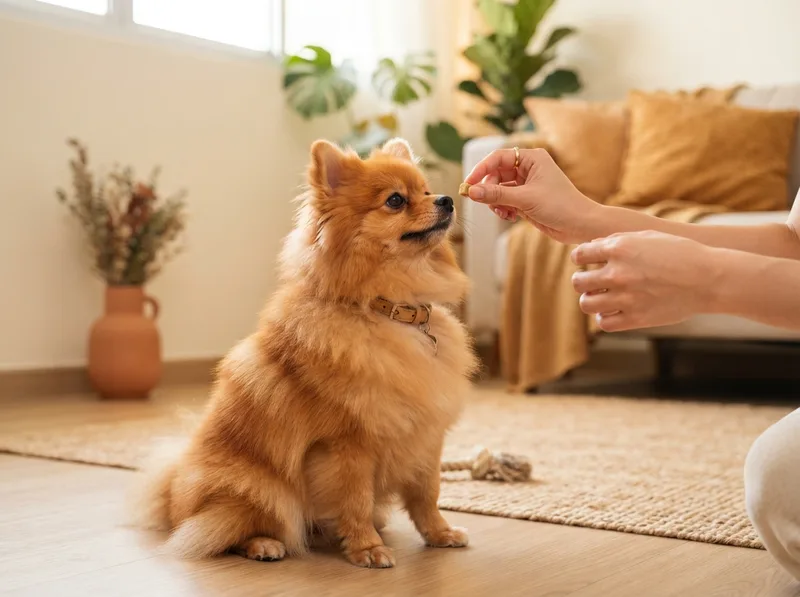
Pomeranian puppies
From $4,288, all-in
Are Pomeranians easy to train?
Mostly yes. Pomeranians are clever and eager, which makes them trainable learners, though a spirited streak means they do best with short, positive, consistent sessions rather than repetition drills. Start early with reward-based methods and a bored Pom never gets the chance to invent its own habits. For a first-time owner willing to stay consistent, a Pomeranian is trainable.
Clever
Quick, eager learners
Free
First training lesson included
30+
Pomeranians placed
HDB ✓
On the approved list
Spirited, but smart and eager
Pomeranians are a joy to train once you understand what you are working with. That clever spitz brain learns fast, and the breed is genuinely eager to be involved in whatever you are doing, which gives you plenty of willing attention to work with. The catch is the flip side of the same coin: a Pom is bold and a touch stubborn, and a smart dog that is bored or under-stimulated will happily invent its own entertainment, usually something you would rather it did not learn.
So the whole approach is to channel the intelligence, not fight the personality. Keep sessions short, upbeat and frequent, make cooperation the thing that earns rewards, and give that brain real work to do each day. Get that right and a Pomeranian is one of the most rewarding small dogs to train. For the wider picture of what makes them tick, read what Pomeranians are like to live with.
Know your learner
- Clever and eager: learns fast
- Bold and a little stubborn
- A bored Pom invents its own habits
- Short, frequent sessions beat long drills
- Reward cooperation, not just tricks
Toilet training in a flat
Toilet training is the first job for most new owners, and in an HDB flat it is very doable with a routine. Pick one fixed spot for a pee pad or tray and keep it there. Take your Pom to that spot after every sleep, meal and play session, and the moment it goes in the right place, reward immediately and warmly. Small dogs have small bladders, so young puppies simply need frequent, predictable trips, and a regular feeding schedule makes the timing far easier to read.
Expect accidents in the early weeks and treat them as information, not failure. Clean up calmly with an enzyme cleaner so no scent marker is left behind, and never scold after the fact, since your Pom will not connect the telling-off to something that happened minutes ago. Consistency is the whole secret. Our step-by-step potty training guide lays out a full flat-friendly schedule.
Toilet routine
- One fixed pad or tray spot, kept consistent
- Trips after every sleep, meal and play
- Reward the instant it goes in the right place
- Feed on a schedule to predict the timing
- Clean accidents calmly with an enzyme cleaner
Bark control from day one
Bark control is not a separate project you tackle later, it is part of training from the first week. Pomeranians are alert little watchdogs, so some barking is normal and even useful, but the habit is much easier to shape early than to undo once it is established. The method is straightforward: let one or two alerts happen, calmly cue "enough" or "quiet", then reward the instant the barking stops. You are rewarding the off switch, never punishing the alert itself.
Pair that with enough exercise and mental work, because a tired, satisfied Pom has far less reason to bark out of boredom. Be consistent across everyone in the home, and avoid shouting or bark collars, which tend to add anxiety to a sensitive small dog rather than calm. Bark control deserves its own attention, so we have a full guide to Pomeranian barking that goes deeper on triggers and HDB neighbour etiquette.
Bark basics
- Start from the first week home
- Cue "enough", then reward the silence
- Never reward the demand bark with attention
- Tire the mind and body to cut boredom barking
- Skip shouting and bark collars
Socialisation in Singapore
A confident Pom is a well-socialised Pom. The early weeks and months are a valuable window for introducing your puppy, calmly and positively, to the everyday world it will live in: lifts and corridors, the sights and sounds of the void deck, other friendly vaccinated dogs, different people, and being gently handled for grooming and vet visits. The goal is not to overwhelm, but to build a dog that meets new things with curiosity rather than fear or defensive barking.
Go at your puppy’s pace and keep every new experience paired with something good, so the world becomes a friendly place. Socialisation also quietly heads off small-dog syndrome, where a bold little dog with no boundaries starts running the household. Calm, consistent leadership and plenty of positive exposure make a Pomeranian a relaxed, portable companion in a busy city.
Socialise early
- Introduce lifts, corridors and void-deck sounds
- Meet friendly, vaccinated dogs and new people
- Handle paws, ears and mouth for grooming and vet
- Pair every new thing with something good
- Go at the puppy’s pace, never overwhelm
Every puppy we place comes with a free first training lesson with a certified trainer. Ask us how it works and what is covered.
Ask on WhatsAppReward-based methods and the crate
Reward-based training is the right fit for this breed, full stop. Poms respond to praise, food and play far better than to force or scolding, and positive methods protect the trusting, eager temperament that makes them such good companions. Mark the exact moment your dog gets it right, reward generously while learning, and keep sessions short enough that you always finish on a win. A clicker or a consistent marker word makes your timing crisp.
A crate, introduced kindly, is one of the most useful tools you have. Done well it becomes a safe den that helps with toilet training, calm alone-time and settled nights, never a punishment box. Build up to it gradually with treats and short, positive sessions so your Pom chooses to go in. Our crate training guide walks through sizing and a gentle night routine.
Method that fits the breed
- Reward-based only: praise, food and play
- Mark the exact right moment, then reward
- Keep sessions short and end on a win
- Use a clicker or a consistent marker word
- Make the crate a safe den, never punishment
Your free first lesson, and where to start
You do not have to figure this out alone. Every Pomeranian we place comes with a free first training lesson with an AVS-certified trainer, which is a genuinely useful head start: you get breed-specific guidance, your early questions answered, and a confident plan for the first weeks. Most first-time owners do very well with consistent home training plus a session or two of professional help to build confidence and iron out specific issues.
A sensible order of priorities is toilet training and calm settling first, bark control and gentle handling alongside, then socialisation as vaccinations allow, all through short, positive daily sessions. New to Pomeranians entirely? Start with our complete breed guide, then come back here to build the routine that turns a spirited puppy into a well-mannered companion.
First-timer priorities
- Toilet training and calm settling first
- Bark control and handling alongside
- Socialisation as vaccinations allow
- Short, positive daily sessions
- Free first lesson with a certified trainer
The month before your puppy can walk outside
Your puppy comes home at around week 9 and cannot safely walk on public ground until the vaccination course is complete, which is week 12 at the earliest and week 16 if your vet advises the fourth shot. That leaves three to seven weeks sitting squarely inside the socialisation window, the period between roughly eight and sixteen weeks when a puppy decides what is normal for the rest of its life. Waiting it out is the most expensive mistake in this entire guide.
Socialise anyway, just off the ground. Carry the puppy into the lift, along the corridor, past the hawker centre at a distance, and let it watch the world from your arms where the ground is not a risk. Bring the world indoors too: rotate visitors so it meets men, women, children, hats, umbrellas and wheelchairs before week sixteen. Lay down different surfaces at home, a rubber mat, a towel, a baking tray, so tiled floors and grates are not a shock later. Run the vacuum, the blender and the doorbell at low intensity while something good is happening. The goal is not obedience, it is a puppy that finds the world boring in the best possible way.
Indoor socialisation checklist
- Lift and corridor, carried
- A new person every two or three days
- Children, hats, umbrellas, walking sticks
- Four different floor surfaces at home
- Vacuum, blender, doorbell at low volume
- Handling: paws, ears, mouth, daily
- All of it before week 16
Teaching a Pomeranian to accept grooming
Grooming acceptance is training, and it is the piece almost every training guide leaves out. A double-coated dog needs brushing several times a week for fourteen years. A dog that fights the brush turns that into a fourteen-year argument, and the usual result is an owner who brushes less, a coat that mats, and a groomer who has to shave out the mats.
Start in week one, before there is much coat to brush, and keep sessions absurdly short. Touch the brush to the shoulder once, give a treat, stop. Repeat for a few days, then two strokes, then move down the body. Handle paws, ears and mouth daily as a separate game so nail trimming and dental brushing are not the first time anyone has touched those places. Brush on a raised non-slip surface rather than the floor, because a small dog on a table is calmer and you are not chasing it. If the puppy struggles, stop before it escalates rather than finishing the job: ending on a calm note is the entire method.
Handling plan, week one
- Brush touches the body, treat, stop
- Two strokes by day three, then build
- Paws handled daily, one at a time
- Ears and mouth checked daily
- Raised non-slip surface, not the floor
- End calm, always, even if unfinished
What Pomeranians are genuinely hard at
Three parts of Pomeranian obedience are harder than the cheerful training articles suggest, and knowing them in advance saves you from concluding your dog is broken. Off-leash recall is the first. A Pomeranian is independent, easily distracted, and small enough that a moment of poor judgement near a road is fatal. Train recall properly and still use a leash in unfenced space. That is not a training failure, it is appropriate caution for a 2.5 kg dog.
The second is tolerating being ignored. This is a breed that wants to be involved, and demand barking is what a bored, sociable, intelligent dog does when involvement stops. The third is accepting handling by strangers, particularly vets and groomers, if the handling groundwork was not done early. All three are manageable, none is a reason to avoid the breed, and all three get much easier if you start at week nine instead of month six.
Frequently asked questions
Are Pomeranians easy to train?
Yes and no, honestly. Pomeranians are clever and eager, which makes them quick learners, but they are also spirited and a little stubborn, so they need short, positive, consistent sessions rather than repetition drills. Start early with reward-based methods and a bored Pom will not have the chance to invent its own habits. For a first-time owner willing to be consistent, a Pom is very trainable.
How do I toilet train a Pomeranian in an HDB flat?
Set up a fixed pee-pad or tray spot, take your Pom there after every sleep, meal and play session, and reward the instant it goes in the right place. Small bladders mean frequent trips, so expect accidents early and clean them without fuss. Consistency and a routine do the work. Our potty training guide has the full flat-friendly schedule.
When should I start training a Pomeranian puppy?
From the day it comes home. Early weeks are the best window for toilet training, gentle handling, socialisation and bark control, because it is far easier to build a good habit than to undo a bad one. Keep sessions short and fun, and let your Pom learn that calm, cooperative behaviour is what earns rewards.
How do I stop my Pomeranian barking on command?
Let the alert happen, calmly say a cue like "enough" or "quiet", then reward the moment the barking pauses. You are rewarding the off switch, not punishing the alert. Keep it consistent across the household and pair it with enough exercise and enrichment. Our dedicated barking guide covers the full plan, since bark control deserves its own attention.
Do Pomeranians need a professional trainer?
Most first-time owners do well with consistent home training plus one or two professional sessions to build confidence and fix specific issues. Every puppy we place comes with a free first training lesson with an AVS-certified trainer, which is a great way to start on the right foot and get your questions answered by someone who knows the breed.
Why is my Pomeranian being stubborn during training?
A Pom that "won’t listen" is usually bored, over-tired, or being asked for too much at once. Shorten your sessions, raise the value of the reward, train before meals when your dog is keener, and end on a win. That clever spitz brain responds to interesting, rewarding work far better than to repetition or scolding.
Meet your Pomeranian
Come say hello at Balestier
2 Balestier Road #01-701, Singapore 320002 · Weekdays 12pm–6pm · Weekends 10am–6pm. Or message us first: tell us about your home and routine, and we'll tell you honestly if a Pomeranian fits.
Read the barking guide next
Why Pomeranians bark, the four triggers, and how to keep the peace in a shared HDB block.
See the barking guide