Pomeranian blog · By Curious Tails · AVS licensed
Pomeranian Potty Training: The HDB-Friendly Guide
A small dog means a small bladder, so potty training a Pomeranian is all about routine and patience, not punishment. Here is the pee-pad schedule that works in a Singapore flat, plus how to handle the inevitable accidents.
Pomeranian puppies
From $4,288, all-in
How do I potty train a Pomeranian?
Potty train a Pomeranian with a tight, consistent routine. Pick one toilet spot, a pee pad or tray in an HDB flat, and take your pup there after every sleep, meal, drink and play session, plus every couple of hours. Reward the instant it goes, supervise closely between breaks, and clean accidents with an enzyme cleaner so no scent lingers.
1 hr/mo
Bladder control by age
One spot
Keep the toilet consistent
Reward
The instant they go
A few wks
Typical time to get reliable
Small dog, small bladder: set your expectations
A Pomeranian puppy simply cannot hold on for long, and understanding that is half the battle. A helpful rule of thumb is one hour of bladder control for each month of age, so an eight-week pup may need the toilet roughly every two hours during the day, and always right after waking, eating, drinking and playing. This is not stubbornness, it is biology, and it improves steadily as your Pom grows.
Set the routine up to succeed rather than to catch failures. Frequent breaks, a fixed toilet spot and generous praise turn potty training from a battle into a habit. It slots neatly into the wider house-training covered in our Pomeranian training guide.
Set expectations
- One hour of control per month of age
- Breaks after sleep, meals, drinks, play
- Roughly every two hours for a young pup
- Control improves steadily with age
- Design the routine to win, not to catch failures
The pee-pad schedule for an HDB flat
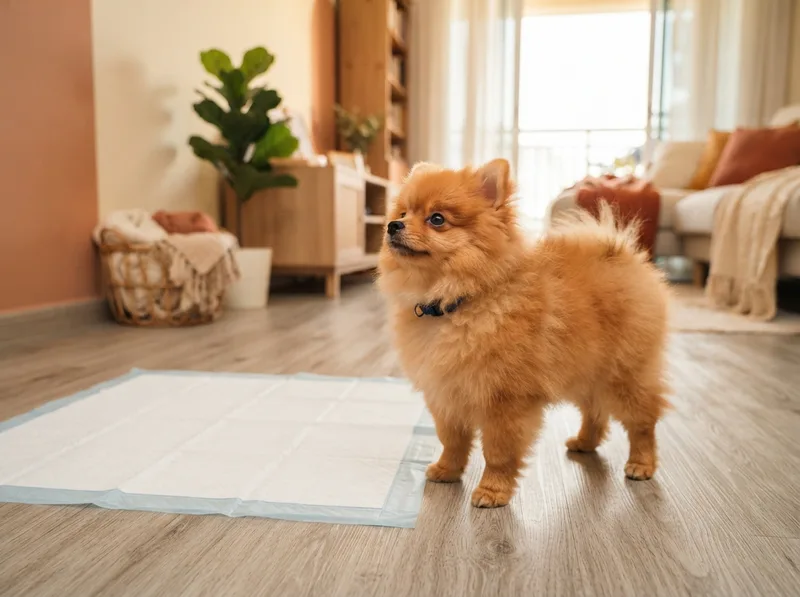
In a flat, a pee pad or pad tray in one consistent spot is the simplest way to start. Choose a location away from your Pomeranian's bed and food, ideally in a quiet corner it can reach easily. Take your pup to that exact spot on a schedule: first thing in the morning, after every meal and drink, after every nap and play session, and every couple of hours in between. Stay with it, wait, and the moment it toilets on the pad, reward immediately with a treat and warm praise so the pad becomes the obvious place to go. Keep a simple log for the first week so the whole household follows the same timings.
How the crate speeds it up
Crate training and potty training reinforce each other beautifully. Because a puppy naturally avoids soiling where it sleeps, a correctly sized crate helps build early bladder control, and every time you let your Pom out you carry it straight to the pad and reward a success. The crate schedule and the toilet schedule become a single predictable rhythm, which is exactly what a young dog needs.
Keep crate time short and toilet breaks frequent, especially at first. For the full method, read our Pomeranian crate training guide, then run the two routines together.
Crate plus toilet
- Puppies avoid soiling their den
- Straight from crate to the pad
- Reward every success at once
- One predictable daily rhythm
- Short crate time, frequent breaks
Handling accidents the right way
Accidents are part of the process, not a sign of failure. If you catch your Pomeranian mid-accident, calmly interrupt and carry it to the pad, then reward if it finishes there. Never scold or rub its nose in a mess, as that only teaches a small, sensitive dog to hide when it needs to go. If you find an accident after the fact, simply clean it up and tighten the schedule.
Cleaning matters more than owners expect. Use an enzyme cleaner, not just a household spray, so no lingering scent invites a repeat in the same spot. A dog that keeps returning to one corner is usually following a smell you cannot detect.
Accident rules
- Interrupt calmly, carry to the pad
- Never scold or punish accidents
- Clean with an enzyme cleaner
- Remove scent so it is not a repeat spot
- Tighten the schedule, do not blame the pup
Every Pomeranian we place comes with a free first training lesson with an AVS-certified trainer, so you can start potty and crate training on the right foot. Ask us how it works.
Ask on WhatsAppConsistency is the whole secret
If there is one thing that makes or breaks potty training, it is everyone in the home doing the same thing. Agree on one toilet spot, one set of timings and one reward routine, and stick to them. A puppy cannot learn the rules if they change from person to person or day to day. Most Pomeranians become reliable within a few weeks of steady routine, with the occasional accident fading over a couple of months as bladder control matures.
If a fully trained Pomeranian suddenly starts having accidents, do not assume it is naughtiness. Check the routine first, then see a vet to rule out a urinary or health issue. Calm consistency, not punishment, is what gets you a cleanly toilet-trained dog for life.
Make it stick
- One spot, one schedule, one reward routine
- Every family member does the same
- Reliable within a few weeks for most Poms
- Occasional accidents fade over a couple of months
- A sudden change in a trained dog: see a vet
Moving from pads to outdoors
Your puppy learns on pads because it arrives at around nine weeks and cannot safely walk on public ground until the vaccination course finishes at week 12 or 16. That means almost every Singapore Pomeranian is pad trained first and has to be transitioned later, and the transition is the step no guide bothers to document.
Do it by moving the pad, not by removing it. Shift it a metre closer to the front door every two or three days until it sits by the entrance, so the puppy is already walking towards the door when it needs to go. Then take a used pad outside to your chosen spot and put it down there, so the scent cue travels with you. Use the same cue word you have been using indoors, reward outdoors within two seconds, and take the puppy out at the times it already reliably goes rather than randomly. Keep one pad indoors for a good month after outdoor toileting starts working, because removing it early is how owners lose the reliability they spent two months building.
Transition steps
- 1. Move the pad a metre every 2 to 3 days
- 2. Park it by the front door
- 3. Take a used pad to the outdoor spot
- 4. Same cue word, indoors and out
- 5. Reward within two seconds, outdoors
- 6. Keep one indoor pad for another month
When a trained dog starts having accidents again
Regression in a previously reliable dog is a symptom, not a training failure, and the order in which you investigate it matters. Rule out medical causes first. A urinary tract infection, bladder stones or early kidney disease all present as sudden loss of house training, and no amount of retraining fixes any of them. If the change was abrupt, see a vet before you change anything else.
Once medical is excluded, look at what changed in the household. A new work schedule, a house move, renovation noise next door, a new baby, or a visitor staying over are all common triggers, and the answer is usually to tighten the schedule back to puppy frequency for a fortnight rather than to correct the dog. The third possibility is marking rather than emptying, which looks different: small volumes, vertical surfaces, often after a new dog has visited. That one is a training and management problem, and in an intact male it frequently improves after sterilisation.
Investigate in this order
- 1. Medical: vet first if sudden
- 2. Routine change: tighten the schedule
- 3. Marking: small volume, vertical surface
- Clean with an enzyme cleaner, not bleach
- Never punish after the fact
- Go back to puppy frequency for two weeks
The mechanics: bladder capacity, timing and rewards
Bladder capacity is the constraint everything else works around, and the usual rule of thumb is the puppy's age in months plus one, in hours. A two-month-old manages about three hours, a four-month-old about five. That is the ceiling in ideal conditions, not a target, and it shrinks after water, sleep and excitement.
Build the schedule around the four reliable triggers rather than the clock alone: first thing on waking, after eating, after play, and last thing before bed. A pad holder stops a puppy dragging or shredding the pad, and keeping the pad in a fixed corner of the playpen gives the scent somewhere consistent to accumulate, which is what draws the puppy back to the right spot.
Reward timing decides how fast this sticks. Use a marker word, one short syllable the instant the puppy finishes, then the treat within two seconds. Praise delivered thirty seconds later, back inside the flat, teaches the puppy that coming inside is rewarding and nothing about where it went. Night toileting fades on its own as capacity grows, usually between four and six months. When you transition to outdoors, pick one grass patch and use it every time so the scent cue does the work. Do not expect small breed reliability before four to six months, and do not treat scent marking, which is small volume against a vertical surface, as a failure of house training. It is a different behaviour with a different fix.
Timing rules
- Capacity: age in months plus one, in hours
- On waking, after eating, after play, before bed
- Pad holder in a fixed playpen corner
- Marker word, then treat within 2 seconds
- Night toileting fades at 4 to 6 months
- One grass patch when moving outdoors
- Marking is not a toilet-training failure
Frequently asked questions
How long does it take to potty train a Pomeranian?
With a consistent routine most Pomeranians are reliably pad-trained within a few weeks, though the odd accident can continue for a couple of months as bladder control matures. Small breeds have small bladders, so frequent breaks and steady patience matter more than speed. Consistency from every family member is what makes it click.
How often does a Pomeranian puppy need to pee?
Very often at first. A useful guide is one hour of bladder control per month of age, so an eight-week puppy may need a toilet break roughly every two hours in the day, plus right after waking, eating, drinking and playing. As your Pom grows it can hold on longer, but early on, frequent breaks prevent accidents.
Should I use pee pads or take my Pomeranian outside?
In an HDB flat many owners start with pee pads or a pad tray indoors, which suits a small bladder and busy schedules, and it works well. You can later teach outdoor toileting too if you wish. The key is to pick one clear spot, be consistent, and reward every success there, indoors or out.
Why does my Pomeranian keep having accidents?
Usually the routine is too loose, breaks are too far apart, or a past accident spot still smells like a toilet. Tighten the schedule, clean accidents with an enzyme cleaner so no scent remains, supervise closely, and reward every correct toilet. If accidents suddenly increase in a trained dog, see a vet to rule out a health issue.
Meet your Pomeranian
Come say hello at Balestier
2 Balestier Road #01-701, Singapore 320002 · Weekdays 12pm–6pm · Weekends 10am–6pm. Or message us first: tell us about your home and routine, and we'll tell you honestly if a Pomeranian fits.
Pair it with crate training
The crate and the pee pad work best as one routine. Read the crate training guide next.
Read crate training