Pomeranian blog · By Curious Tails · AVS licensed
Pomeranian Crate Training: A Step-by-Step Guide
A crate is not a cage, it is a cosy den your Pomeranian learns to love. Done gently, crate training gives your pup a safe retreat, calmer nights and faster potty training. Here is the full step-by-step for a Singapore home.
Pomeranian puppies
From $4,288, all-in
How do I crate train a Pomeranian?
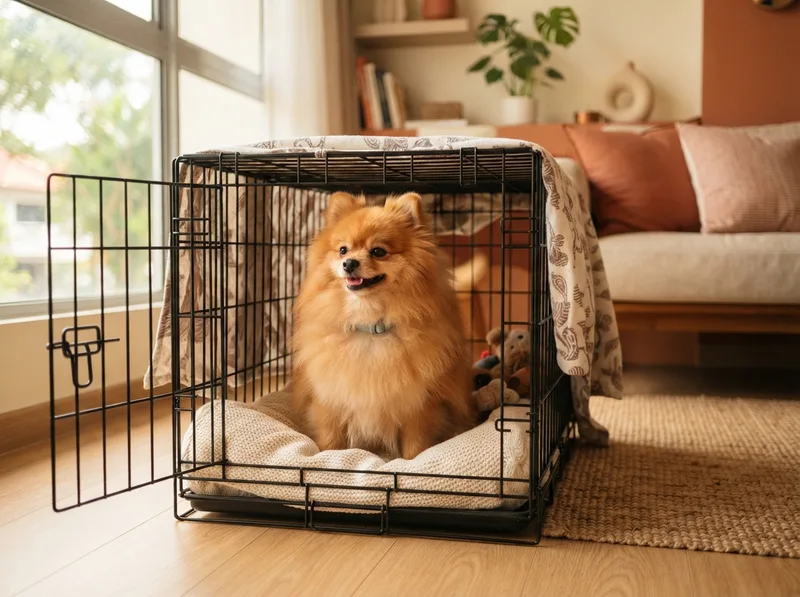
Crate train a Pomeranian by making the crate a rewarding place, never a punishment. Start with the door open, feed meals and treats inside, and let your pup explore freely. Build up closed-door time in seconds, then minutes. Keep the crate just big enough to stand and turn, and place it in your bedroom for the first nights to settle sleep.
~24 in
Crate size for most Poms
Door open
How every session starts
Bedroom
Crate spot for early nights
1 hr/mo
Rough daytime holding rule
Why a crate helps a Pomeranian settle
Dogs are den animals, and most Pomeranians feel calmest in a small, enclosed space they can call their own. A properly introduced crate becomes exactly that: a safe retreat for rest and sleep, a tool that speeds up potty training because pups avoid soiling where they sleep, and a secure spot when the doorbell sets off that famous Pom alarm. Used well, it lowers stress for the whole household.
The golden rule is that the crate is always positive. It is never used for punishment and never becomes an all-day cage. Think of it as a bedroom, not a prison, and your Pomeranian will come to choose it on its own.
What the crate is for
- A safe den for rest and sleep
- A calm retreat from doorbell chaos
- A boost to potty training
- Never a punishment or all-day cage
- A bedroom, not a prison
Get the crate size right
Size is where owners most often go wrong. The crate should be just big enough for your Pomeranian to stand up, turn around and lie down comfortably, and no bigger. A small crate, commonly cited around 24 inches long, suits most adult Poms. If the space is too large a puppy will simply toilet in one corner and sleep in another, which undoes the potty-training benefit. For a growing pup, buy for the adult size and use the divider panel to keep the usable area small, expanding it as your Pomeranian grows. Add soft, washable bedding and keep it cosy.
Building a positive association, step by step
Take it in small, upbeat stages over several days. Start with the door open and toss treats inside so your pup wanders in and out freely. Feed meals in the crate. When your Pomeranian is happy going in, close the door for a few seconds while it eats, then open it before any fuss. Slowly stretch the closed-door time, staying in the room, then start stepping away for short periods.
Never force your pup in, never let the crate become the place bad things happen, and always let it out calmly rather than during a whine. Pair the crate with a chew or stuffed toy so settling inside is genuinely enjoyable. Our Pomeranian training guide puts this into the wider house-training picture.
The step ladder
- Door open, toss treats inside
- Feed every meal in the crate
- Close the door for seconds, then minutes
- Step away only once settled
- Let out calmly, never mid-whine
The night routine
Nights are where crate training earns its keep. For the first week or two, place the crate right beside your bed so your puppy can hear and smell you, which hugely reduces crying. Take away water an hour before bed, give a final toilet trip immediately before lights out, and settle your Pom with a soft toy. Expect one or two middle-of-the-night toilet breaks for a young puppy: carry it out quietly, no play, then straight back to the crate.
A whimper for the toilet is real; a demand-bark for attention is different, and answering it teaches your Pom to protest. For the whole first-night plan, read our guide to your first night with a Pomeranian puppy.
Night checklist
- Crate beside your bed at first
- Water up an hour before bed
- Toilet trip right before lights out
- Quiet night toilet breaks, no play
- Do not reward demand-barking
Every Pomeranian we place comes with a free first training lesson and a playpen setup at delivery, so you start crate training on the right foot. Ask us how the setup works.
Ask on WhatsAppCrate training and potty training go together
Crate training and toilet training are two halves of the same routine. Because a puppy will not want to soil its den, the crate teaches early bladder control, and every time you let your Pom out you carry it straight to its pee pad or toilet spot and reward the moment it goes. The crate schedule and the toilet schedule become one predictable rhythm your puppy quickly learns.
Keep sessions short, breaks frequent and rewards generous, and the two skills reinforce each other. Our full Pomeranian potty training guide walks through the pee-pad schedule that pairs with the crate in an HDB flat.
Two skills, one routine
- Puppies avoid soiling their den
- Straight from crate to toilet spot
- Reward the instant they go
- One predictable daily rhythm
- Short crate time, frequent breaks
Crate training an adult Pomeranian
Adult dogs can be crate trained, and rehomed Pomeranians often need it more than puppies do. The method is the same and the pace is slower, because an adult arrives with opinions about enclosed spaces that a nine-week puppy has not formed yet.
Spend a full week on the crate simply existing: door removed or fixed open, bedding that already smells of the dog, meals fed just inside, and no attempt to close anything. Only when the dog walks in unprompted and lies down do you begin closing the door for seconds at a time. The mistake that ruins this is shutting an anxious adult in and waiting for it to calm down. That is flooding, it does not teach acceptance, and with a dog that has previously been confined badly it can make the crate permanently unusable. Expect three to four weeks rather than one to two, and stop the session the moment the dog looks worried rather than after it has settled.
Adult dog timeline
- Week 1: door open, meals inside, no closing
- Week 2: door closed for seconds, then reopened
- Week 3: short closed periods while you stay
- Week 4: you leave the room briefly
- Never shut an anxious dog in to settle
- Stop before the worry, not after it
When crate training is not working
Four failures account for nearly all of it, and each has a specific fix. If the puppy cries the moment the door closes, you moved too fast: go back two steps and rebuild duration in seconds rather than minutes. If the puppy toilets in the crate, it is either too large, in which case add a divider, or the toilet schedule is too long for its age.
If the puppy settles at night but refuses the crate during the day, the crate has become associated only with being left, so start feeding meals and giving chews in it while you are sitting right there. And if the dog is genuinely panicking, drooling, scrabbling at the door, or refusing food near the crate, stop. A playpen with an open bed is a legitimate alternative and it gets you almost all of the same benefit. Crate training is a tool for making a dog comfortable, not a target to hit, and a small number of dogs simply never take to it.
Four failures, four fixes
- Cries on closing: rebuild in seconds
- Soils the crate: divider, or shorter schedule
- Refuses by day: feed meals inside, you present
- Panics: stop, use a playpen instead
- Never use the crate as punishment
- A playpen is a valid substitute
Crate choice, and the details that decide it
A 24 inch crate suits almost every adult Pomeranian: enough room to stand, turn and lie flat, and no more. The temptation is to buy bigger so the dog has space, and the result is crate soiling, because a puppy with a spare end will use it. If you are buying one crate for the whole life of the dog, get a divider and shrink the usable area while it is small.
Feeding in the crate is the fastest route to a positive association, faster than any amount of coaxing with the door open. Put the bowl at the back, walk away, and let the dog decide the crate is where good things happen. Duration building comes next: seconds, then a minute, then five, always finishing before the dog is worried rather than after. A covered crate settles most dogs by removing the visual traffic of a flat, though a few find it claustrophobic, so try it and watch.
Whining needs a diagnosis before a response. A puppy that whines within a minute of going in is asking to be let out and should be ignored until it pauses. A puppy that settles and then whines at 3am probably needs the toilet. Getting that distinction right is most of crate training. The pay-off arrives later and away from home: a dog that accepts a travel crate, a vet stay, or an overnight at the clinic without adding fear to whatever brought it there, and a dog for whom separation is unremarkable because being alone in a small space was never a punishment. Desensitisation to the crate is the same skill you will use for grooming and for the car.
Crate details
- 24 inch crate suits most adult Poms
- Divider while the puppy is small
- Feed meals inside, bowl at the back
- Build duration in seconds, not minutes
- Try a covered crate, watch the response
- Whine on entry: wait for a pause
- Whine at 3am: toilet trip, no conversation
Frequently asked questions
Is crate training cruel for a Pomeranian?
No, when done kindly a crate becomes a den your Pomeranian chooses for itself. Dogs are den animals and most feel safest in a small, cosy space. The crate is never a punishment or an all-day cage. Used for rest, sleep and calm downtime, it lowers stress and speeds up potty training.
What size crate does a Pomeranian need?
A small crate, commonly cited around 24 inches long, suits most adult Pomeranians. It should be just big enough to stand up, turn around and lie down comfortably, no larger. Too much space lets a puppy toilet in one corner and sleep in another. For a growing pup, use a divider to expand the space as it grows.
How long can a Pomeranian stay in a crate?
Keep it short. A young puppy can hold on for roughly one hour per month of age, so an eight-week pup needs a toilet break about every two hours in the day. Overnight they last longer as they sleep. The crate is for rest and sleep, never a place to leave a dog for a full working day.
Where should I put a Pomeranian crate at night?
Start with the crate in your bedroom for the first nights so your puppy can hear and smell you and settle. This dramatically reduces night crying. Once your Pom sleeps soundly you can gradually move the crate to its permanent spot if you prefer. Keep it out of direct draughts, sun and noisy walkways.
Meet your Pomeranian
Come say hello at Balestier
2 Balestier Road #01-701, Singapore 320002 · Weekdays 12pm–6pm · Weekends 10am–6pm. Or message us first: tell us about your home and routine, and we'll tell you honestly if a Pomeranian fits.
Master the pee-pad schedule too
Crate and toilet training work best together. Read the potty training routine next.
Read potty training