By Curious Tails · AVS licensed
Your Pomeranian Puppy's First Night Home
The first night sets the tone for everything that follows. Your Pomeranian puppy has just left its littermates for a strange new home, so a little planning turns a stressful night into a calm start. Here is exactly how to settle a new Pom.
Pomeranian puppies
From $4,288, all-in
How do I settle a Pomeranian puppy on the first night?
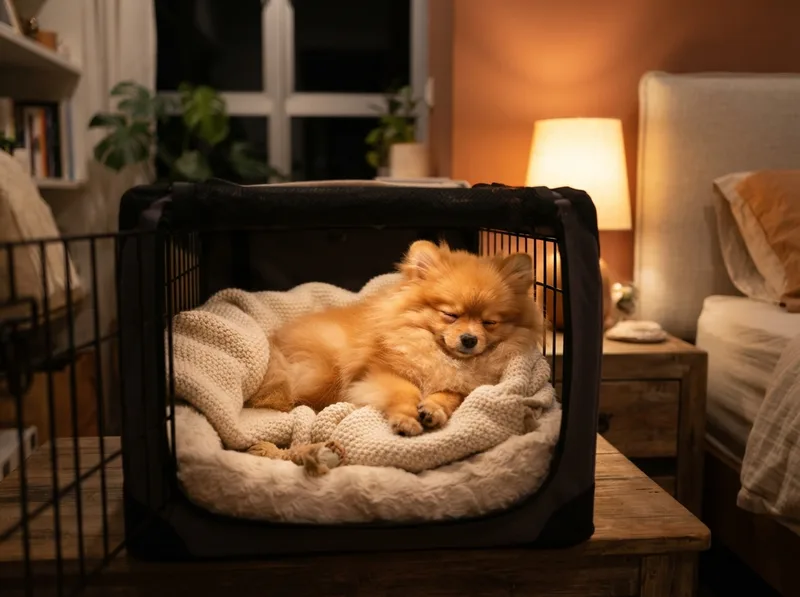
Set up a cosy crate or pen near your bed, take the puppy out for a last toilet trip, and keep the room calm and dimly lit with a warm bed, a comfort item and soft background sound. Expect some crying, respond quietly to real toilet needs, feed small and often, and watch tiny pups for low blood sugar.
~Week 9
When your pup comes home
Crate / pen
Safe, den-like sleeping
Small & often
Feeding tiny pups
Stay calm
Crying is normal
Set up before the puppy arrives
Do the work before your Pom walks through the door. Our puppies go home at around nine weeks, after their second vaccination, and they arrive with a starter kit to get you going. Set up a safe base in a quiet corner: a crate or a playpen with a warm, soft bed, water, a toilet spot with pads, and a couple of toys. Puppy-proof the area by clearing cables, small objects and anything chewable, and decide where the puppy will sleep before nightfall rather than in the middle of the first cry.
Place the sleeping crate or pen near your bed for the first nights. A nine-week-old Pom left alone in a far room will cry from loneliness, and keeping it close cuts that dramatically while you both get some sleep. You can move it gradually to its permanent spot once the puppy is settled. The crate training guide covers making that space a place your Pom genuinely likes.
Have ready on day one
- A crate or playpen with a warm, soft bed
- Water and a toilet spot with pads
- A couple of safe puppy toys
- A puppy-proofed, cable-free corner
- A comfort item and soft background sound
Handling the crying and getting through the night
Some crying on the first night is normal and expected. Your puppy has just left its littermates and every familiar smell, so it is not being difficult, it is unsettled. The aim is to comfort without teaching the puppy that crying summons a party. Keep the pen close, offer warmth and a soft comfort item, and keep the room dim and quiet. A gentle background sound can mask the silence that makes a lone puppy anxious.
Tire the puppy gently with a little play before bed, then take it out for a final toilet trip right before settling. Very young puppies cannot hold on all night, so expect one or two toilet breaks. Keep those breaks calm, businesslike and boring: out, toilet, quiet praise, back to bed, no playtime. Respond to genuine needs, avoid rewarding pure protest with fuss, and know that consistency over the first week is what settles almost every puppy.
Through the first night
- Gentle play, then a final toilet trip before bed
- Keep the pen close so the pup is not alone
- Dim, quiet room with soft background sound
- Calm, boring night-time toilet breaks
- Comfort real needs, do not reward protest
Feeding and the hypoglycaemia watch
Feeding matters more than usual in the first days, and not only for comfort. Very small, young toy-breed puppies, Pomeranians included, are prone to juvenile hypoglycaemia, a drop in blood sugar that can happen when a tiny pup gets stressed, cold, over-tired or skips meals. The move to a new home ticks several of those boxes at once, which is exactly why the first night deserves attention.
Prevent it with small, frequent meals of the food your puppy is already used to, rather than large gaps between feeds, and keep the puppy warm and rested rather than over-handled and over-tired. Learn the warning signs: wobbliness, weakness, lethargy, and pale gums. If you see them, offer food at once and contact your vet promptly, and if the puppy is very dull or unresponsive treat it as urgent. This is general guidance, not a substitute for your vet, and you can always message us if something does not look right.
Hypoglycaemia: prevent and spot
- Feed small, frequent meals of the usual food
- Keep the puppy warm and well rested
- Do not let a tiny pup get over-tired
- Watch for wobbliness, weakness, pale gums
- Offer food and call your vet at the first signs
Building the routine from night one
The first night is really the first step of the routine that will settle your Pom for good. From day one, keep meals, toilet trips, play and sleep at consistent times, and take the puppy to its toilet spot after every sleep, meal and play session. Predictability is deeply reassuring to a small dog and speeds up both toilet training and confidence.
Go gently on visitors and outings in the first days while the puppy finds its feet, and keep early handling calm and positive. The habits you set now, calm crate time, a steady rhythm, rewarding quiet and good toileting, are the foundation everything else builds on. Our Pomeranian training guide takes it from here, through toilet training, bark work and early socialisation.
Set the routine early
- Consistent meal, toilet, play and sleep times
- Toilet trip after every sleep, meal and play
- Calm, positive early handling
- Go gently on visitors in the first days
- Reward quiet and good toileting from day one
Bringing a Pomeranian home soon? Message us before the big day and we will walk you through exactly how to prepare, and we are here if anything looks off in the first nights.
Ask on WhatsAppWhat the first week actually looks like, night by night
Most guides stop after night one, which is the least useful night to plan for because nobody sleeps anyway. The pattern across the week is what tells you whether the routine is working, and it is remarkably consistent across the puppies we have placed.
Night one is loud and short on sleep. Expect crying in bursts, one or two toilet trips, and a puppy that settles best when it can hear you breathing. Nights two and three are usually the hardest, not the first, because the novelty has worn off and the puppy has worked out that noise sometimes brings company. Hold the line here and the rest of the week improves quickly. By nights four and five most puppies are settling within ten or fifteen minutes and waking once. By nights six and seven you are often down to a single stretch of five or six hours, which is the point at which the routine has genuinely taken.
Two things reliably break this arc. Moving the crate somewhere new partway through resets the clock. So does responding to every sound, because a puppy that gets attention for crying on night three will still be crying on night ten. Go to it for a toilet trip, calmly and without conversation, and go back to bed.
The first seven nights
- Night 1: loud, 1 to 2 toilet trips
- Nights 2 to 3: usually the hardest
- Nights 4 to 5: settles in 10 to 15 minutes
- Nights 6 to 7: one stretch of 5 to 6 hours
- Do not move the crate mid-week
- Toilet trips: calm, quiet, straight back
The evening kit, and what to watch
Have the crate made up before the puppy arrives, not after. Soft bedding it cannot swallow, a pee pad in a fixed corner of the pen, a water bowl it cannot tip, and something carrying a familiar scent from the shop, which is the single cheapest settling aid there is. A radio or fan providing white noise masks corridor footsteps and lift doors, both of which cause more night waking than the strangeness of the room does.
Keep the feeding schedule you were given rather than switching food or timing on night one. Very small Pomeranian puppies run low on glucose faster than bigger breeds, so small meals at regular intervals are a safety measure and not fussiness. Missing a meal because a puppy is unsettled is the most common way this goes wrong.
Learn the signs before you need them. A hypoglycaemic puppy goes quiet and wobbly, then weak, and its gum colour pales from healthy pink towards white or grey. Lift the lip and look, because that check takes two seconds and tells you more than any amount of watching from across the room. If you see it, that is a vet call rather than a wait-and-see. Save your vet contact and an after-hours number in your phone before the first night, not during it. For everything else, use a quiet settling cue, the same two words every time, so the puppy learns the sound that means sleep.
Ready before arrival
- Crate made up, soft bedding
- Pee pad in a fixed corner
- Familiar-scented item from the shop
- Radio or fan for white noise
- The feeding schedule, unchanged
- Vet and after-hours numbers saved
- One settling cue, used every time
Frequently asked questions
How do I get a Pomeranian puppy to sleep on the first night?
Set up a cosy crate or pen near you, tire the puppy gently before bed, take it out for a last toilet trip, and keep the room calm and dimly lit. A warm, soft bed, a comfort item and a soft background sound help. Expect some crying at first. Keep responses low-key, meet genuine toilet needs, and most puppies settle within a few nights.
Should a Pomeranian puppy sleep in a crate?
A crate or a playpen is ideal for a first night: it is safe, den-like and helps with toilet training. Keep it near your bed at first so the puppy is not isolated, which reduces crying. Never use the crate as punishment. Introduce it as a positive, cosy space. Our crate training guide covers building a happy, willing crate step by step.
Is it normal for a Pomeranian puppy to cry on the first night?
Completely normal. Your puppy has just left its littermates and everything familiar, so some crying and restlessness on the first night or two is expected. Keep it near you, offer warmth and a comfort item, and respond calmly to real toilet needs without making a big fuss. Consistency over the first week settles most puppies quickly.
What is juvenile hypoglycaemia and how do I prevent it?
It is a drop in blood sugar that very small, young toy-breed puppies are prone to, especially when stressed, cold, over-tired or if they skip meals. Signs include wobbliness, weakness, lethargy and pale gums. Prevent it by feeding small, frequent meals, keeping the puppy warm and not letting it get over-tired. If you see the signs, offer food and contact your vet promptly.
Meet your Pomeranian
Come say hello at Balestier
2 Balestier Road #01-701, Singapore 320002 · Weekdays 12pm–6pm · Weekends 10am–6pm. Or message us first: tell us about your home and routine, and we'll tell you honestly if a Pomeranian fits.
Make the crate a happy place
Next: crate training a Pomeranian step by step, so the pen becomes a space your puppy chooses on its own.
Read the crate guide