Pomeranian blog · By Curious Tails · AVS licensed
Getting a Second Dog With a Pomeranian
Thinking of adding another dog to the family? Pomeranians are sociable little characters, but a good match and a slow, structured introduction make all the difference. Here is how to grow your pack the right way in Singapore.
Pomeranian puppies
From $4,288, all-in
Do Pomeranians get on with other dogs?
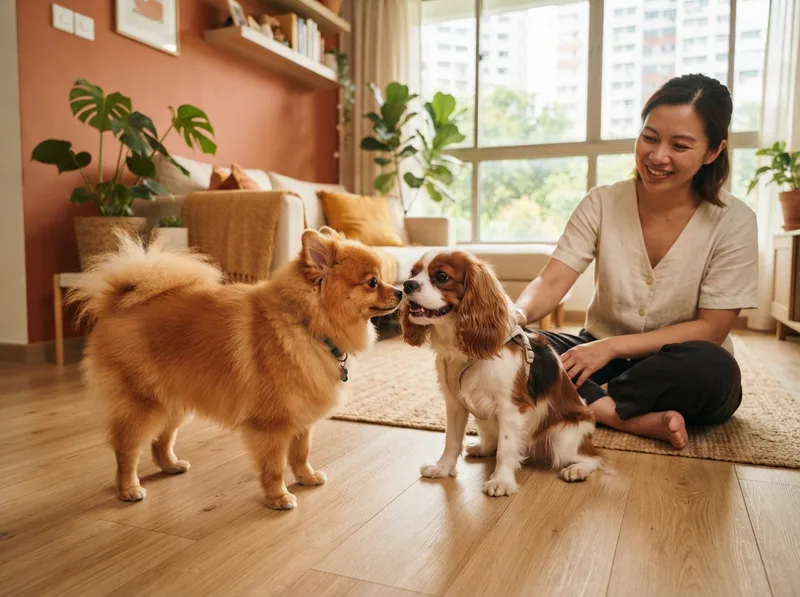
Yes, most well-socialised Pomeranians enjoy canine company. They are confident rather than shy, so the usual challenge is a bold Pom over-asserting itself, not being bullied. With a sensible match, a slow introduction on neutral ground and steady supervision, a Pomeranian and a second dog usually settle into good companions within a few weeks.
2–4 wks
Typical time to settle
Neutral
Where first meetings happen
Opposite
Often the easiest sex pairing
Separate
Feed the dogs apart, early on
Big personality, small body: the dynamic to manage
Pomeranians rarely lack confidence. That is part of their charm, and it is also the thing to manage when a second dog arrives. A Pom will often try to run the show regardless of size, which is delightful with a well-matched companion and risky around a boisterous large dog that plays rough. Your job is to keep early interactions calm and set both dogs up to succeed.
Understanding your Pomeranian's baseline helps. If yours is a classic alert, vocal little watchdog, read our temperament guide so you know what you are working with before a newcomer changes the household balance.
Before you commit
- Poms are confident, not timid
- Watch for a Pom over-asserting with big dogs
- Match energy levels, not just size
- Opposite-sex pairings often settle easiest
- Have a plan before the new dog arrives
The first meeting: neutral ground, no pressure
Do not introduce dogs nose-to-nose in your living room, where your Pomeranian already feels ownership. Meet on neutral ground instead, a quiet corridor, a calm stretch of pavement or a shared void deck, with each dog on a loose lead and a handler. Let them walk parallel a few metres apart first, reward calm glances, then allow a brief sniff and move on before either dog gets over-excited. Short and positive beats long and tense every time. Several relaxed neutral meetings before anyone comes home make the first day indoors far smoother.
Resource guarding and jealousy
The most common friction point is not aggression, it is resources. Food bowls, favourite toys, the sofa spot and above all your attention are the things a Pomeranian may guard from a newcomer. Prevent it from becoming a habit: feed the dogs in separate spots, pick up high-value chews when they are together at first, and give your original dog attention first so it never has to compete to feel secure.
Keep each dog's routine as intact as possible, and reward calm, sharing behaviour heavily in the early weeks. Guarding that is managed from day one usually fades fast; guarding that is ignored can harden into a lasting problem.
Prevent guarding early
- Feed the dogs in separate spots
- Pick up high-value chews when together
- Give your first dog attention first
- Supervise all shared toys and spaces
- Reward calm, sharing behaviour heavily
Go at the slower dog's pace
There is no prize for rushing. Some pairs are lounging together within a fortnight; others need a couple of months of patient, supervised time. Let the more cautious dog set the speed. Use baby gates or a playpen so the dogs can see and smell each other safely between sessions, keep greetings short, and separate them completely when you cannot supervise until you are confident they are relaxed together.
Structured training helps enormously, because two dogs who both understand basic cues are far easier to manage together. Our guide to basic training for a Pomeranian covers the foundations, and every puppy we place comes with a free first lesson with an AVS-certified trainer.
Pacing the introduction
- Weeks, not days, to fully settle
- Let the more cautious dog set the pace
- Use gates or a playpen between sessions
- Separate fully when unsupervised at first
- Train basic cues with both dogs
Already have a dog and thinking of adding a Pomeranian? Tell us your current dog's age, sex and temperament, and we will help you pick a pup that fits the pack.
Ask on WhatsAppChoosing the right second Pomeranian
When the newcomer is the Pomeranian, you get to choose for fit. As a general guide an opposite-sex, sterilised pairing tends to have the smoothest long-term dynamic and the least rivalry, though temperament and good introductions still matter more than any rule. Match energy too: a placid senior may not thank you for a whirlwind puppy, while a lively young dog may love the company.
This is exactly the kind of decision we help families think through. We would rather help you choose a puppy that genuinely suits your household than simply sell you one. Browse the available puppies and message us with your current dog's details.
Match for harmony
- Opposite-sex pairings often easiest
- Sterilisation reduces same-sex rivalry
- Match energy, not just size
- Factor in your current dog age and health
- We help you choose for fit, not just sell
Can you even keep two dogs where you live?
Before any of the behavioural questions, there is a legal one, and for a large share of readers it ends the discussion. HDB permits one approved dog per flat. Not one per adult, not one per bedroom. One. If you live in an HDB flat and you already have a Pomeranian, a second dog is not an option regardless of how well the two would get along.
Private housing is governed differently. A condominium follows its own MCST by-laws, which may permit two dogs, may cap by weight, or may prohibit pets entirely, so check your by-laws rather than assuming the more permissive answer. Landed property is generally the least restricted. Whatever the housing type, every dog needs its own annual AVS licence, so two dogs means two licences and two renewals. The one-dog-per-flat rule page covers the approval side in full.
Before you plan anything
- HDB: one approved dog per flat
- Condo: check your MCST by-laws
- Landed: generally least restricted
- Rental: check the tenancy agreement
- Each dog needs its own AVS licence
- Renewals are annual, per dog
Will a second dog stop the barking?
No, and this is the most common reason people arrive at this article. The reasoning sounds sensible: a dog barks because it is lonely, so give it company. In practice a second dog rarely solves separation barking, because the dog is attached to you rather than to dogs in general, and the presence of another animal does not substitute for the person it is actually waiting for.
What frequently happens instead is that the barking doubles. Alert barking is socially contagious, so one dog starting means two dogs finishing, and a resident dog with a barking habit teaches it to the newcomer within days rather than the other way around. If noise is your problem, fix the noise first and consider the second dog afterwards on its own merits. What actually reduces barking is environment, routine and training, in that order, and none of the three requires another dog.
Second dog: what it does and does not fix
- Does not fix separation barking
- Does not replace human company
- Often doubles alert barking
- Newcomer learns the resident’s habits
- Does help with daytime boredom, sometimes
- Fix the barking first, then decide
Choosing the second dog: size, age and play style
Size matching matters more than breed. A Pomeranian at 2.5 kg can be hurt by ordinary, well-meant play from a 15 kg dog that simply lands badly once. Aim for a second dog within roughly double your Pomeranian's weight, and pay more attention to play style than to the number: a dog that body-slams is a poor match for a toy breed regardless of what it weighs.
On age, a gap of two to four years usually works best. Two puppies raised together, whether littermates or not, tend to bond to each other rather than to you, and the training problems that follow are harder to unpick than anything you avoided. A settled adult and a puppy is the easier combination, provided the adult gets time away from the newcomer.
Introduce on neutral territory rather than in the flat, and start with parallel walking, the two dogs moving in the same direction a few metres apart with a handler each, before any face-to-face greeting. At home, run a gated introduction for the first week and keep supervised sessions short. Separate food bowls and separate beds from day one prevent most guarding before it starts. Do not try to enforce a hierarchy: dogs sort that out and human interference usually makes it worse. Keep individual walks going for both, because a dog that only ever leaves the house with the other dog never learns to be alone. If there is a real fight rather than a noisy disagreement, get professional help early instead of hoping it settles.
Matching checklist
- Within about double your Pom’s weight
- Play style beats breed on paper
- Age gap of 2 to 4 years works best
- Avoid two puppies at once, littermates included
- Meet on neutral territory, parallel walk first
- Separate bowls and beds from day one
- Keep individual walks for both dogs
Frequently asked questions
Do Pomeranians get along with other dogs?
Most well-socialised Pomeranians get on happily with other dogs. They are bold and confident rather than timid, so the usual risk is a Pom over-asserting itself with a much larger dog, not being bullied. Careful, gradual introductions on neutral ground and good supervision give you the best chance of a lasting friendship.
Is it better to get a second dog of the opposite sex?
As a general rule an opposite-sex pairing tends to have the smoothest dynamic and the least same-sex rivalry, especially once both dogs are sterilised. It is not an absolute rule, and individual temperament and good introductions matter more. If you already have a Pomeranian at home, tell us its personality and we will help you match.
How long does it take two dogs to get used to each other?
Plan for weeks, not days. Many pairs are relaxed together within two to four weeks, but some take a couple of months to fully settle. Go at the slower dog's pace, keep early interactions short and positive, feed separately, and never rush face-to-face time. Patience now prevents lasting friction later.
Will my Pomeranian get jealous of a new puppy?
It can, especially a Pom used to being the only dog. Resource guarding of you, toys or food is the most common flashpoint. Protect your first dog's routine, give it attention first, feed the dogs apart and supervise all shared resources early on. Fair, consistent management usually settles jealousy quickly.
Meet your Pomeranian
Come say hello at Balestier
2 Balestier Road #01-701, Singapore 320002 · Weekdays 12pm–6pm · Weekends 10am–6pm. Or message us first: tell us about your home and routine, and we'll tell you honestly if a Pomeranian fits.
Set both dogs up to succeed
Read the training guide first: the basic cues that make life with two dogs far calmer.
Read the training guide