By Curious Tails · AVS licensed
Living With a Pomeranian in an HDB Flat
The approval question is the easy part: yes, the Pomeranian is HDB approved. The real question is what daily life in a flat actually feels like, especially the barking. Here is the honest, lived-in picture of a Pom in an HDB block.
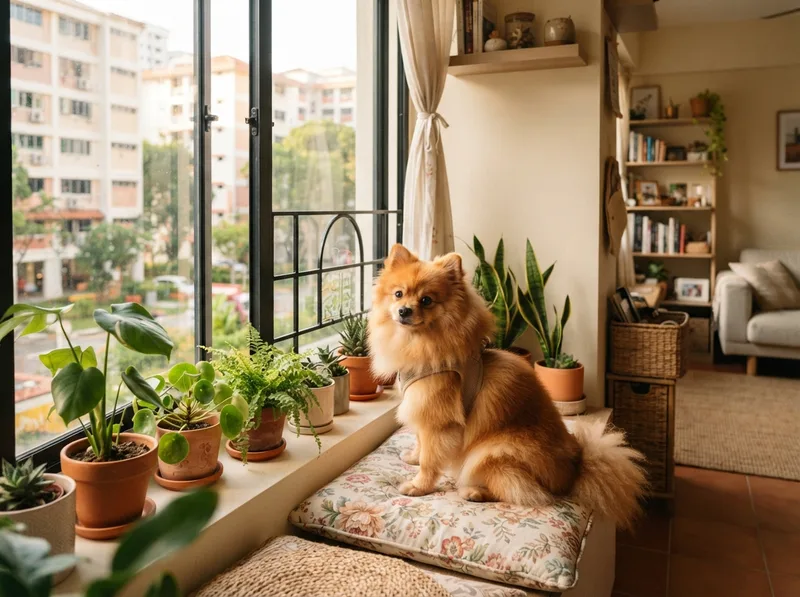
Pomeranian puppies
From $4,288, all-in
Is a Pomeranian good for HDB living?
Yes, for the right owner. A Pomeranian is small, HDB approved and thrives in a flat, with modest exercise needs. The one thing to manage honestly is barking, since Poms are alert little watchdogs and you share walls and corridors with neighbours. Commit to early bark training and a settled routine and it is an excellent flat dog.
HDB ✓
On the approved list
2 short walks
Plus indoor play
Bark training
The non-negotiable
Routine
Keeps a Pom settled
A small dog built for flat life
In pure practical terms, a Pomeranian is close to ideal for an HDB flat. It is tiny, it does not need a garden, its exercise needs are modest, and it is genuinely happy being close to its people indoors. The approval side is the cleanest in the small-breed world too: the Pom is a named breed on the HDB approved list, one dog per flat, with a mandatory annual AVS licence. Those rules, plus the licensing evidence and the first-timer course, live on our HDB approval page.
This post is about the other side of the coin: not whether you are allowed a Pom, but what living with one in a flat is actually like day to day. That story is mostly wonderful, with one honest caveat that every prospective owner should hear before they commit. That caveat is noise.
Why flats suit a Pom
- Tiny footprint, no garden needed
- Modest exercise needs
- Happiest close to its people indoors
- A named breed on the HDB approved list
- One dog per flat, annual AVS licence
Barking and your neighbours
Poms are alert little watchdogs, and in a flat that instinct meets a constant stream of triggers: footsteps in the corridor, the lift chiming, the doorbell, next door's dog, the delivery rider. Left unmanaged, a Pom will announce all of it, and in a block with shared walls that is how you end up with a note under the door. This is the single most important thing to be honest with yourself about before choosing the breed.
The good news is that barking is trainable, not a life sentence. Start bark training from day one, reward quiet, avoid accidentally rewarding the alarm bark with attention, and reduce the triggers themselves: frosted or filmed door glass, a radio or white noise to mask corridor sounds, and not letting the dog patrol the door all day. Most Poms settle into calm flat dogs that only speak up when it matters. Our guide to Pomeranian barking covers the method in full.
Keeping the peace
- Start bark training from day one
- Reward quiet, do not reward the alarm bark
- Reduce door and corridor triggers
- Mask outside noise with a radio or white noise
- Do not let the dog patrol the door all day
Exercise and space inside a flat
A Pomeranian does not need much room to run, but it does need something to do. Physically, a couple of short daily walks in the cool morning and evening hours, plus some indoor play, covers most Poms. What matters just as much is mental work, because a bored, under-stimulated Pom fills the gap with barking and mischief. Short training sessions, puzzle feeders, chews and games give that clever spitz brain a job.
Inside, give the dog its own settled base: a bed or pen in a quieter corner away from the front door, so it is not permanently on guard duty. A small dog fits any flat, but a Pom with nothing to occupy it in a tight space is the recipe for noise. Enrichment is not a luxury here, it is part of responsible flat living. Building good habits early is far easier than fixing them later, which is where training comes in.
Enough for a flat Pom
- Two short walks in the cool hours
- Indoor play and fetch in the hallway
- Puzzle feeders and chews for the brain
- Short daily training sessions
- A settled base away from the front door
Routine, alone time and settling in
Small dogs thrive on predictability, and a steady daily rhythm of walks, meals, play and rest is what turns an excitable puppy into a settled flat companion. Feed at consistent times, walk in the same cool windows, and build in quiet downtime so the dog learns that not every moment is action. A predictable day lowers anxiety, and lower anxiety means less barking.
Being left alone during work hours is manageable for a well-adjusted adult Pom, but it has to be built up gradually. Leave the dog in a safe pen or area with water, toys and a toilet spot, start with short absences and extend slowly, and avoid asking a puppy to hold on too long. Sudden, long absences are a common trigger for stress barking, so ease into it and, where you can, break up the longest days.
A settled daily rhythm
- Consistent meal and walk times
- Built-in quiet downtime each day
- Build alone time up gradually
- A safe pen with water, toys and a toilet spot
- Break up the longest work days where possible
Not sure a Pom suits your flat and your schedule? Tell us about your block, your household and your work hours, and we will give you an honest read before you commit.
Ask on WhatsAppLifts, corridors and void decks
Living with a Pomeranian in Singapore is rarely about space. Shared circulation is, and it is the part nobody explains to a new owner. Your dog will use a lift several times a day with strangers who did not choose to travel with a dog, and how you handle that decides whether the block likes your Pomeranian or tolerates it.
Leash on before the front door opens, every time, with no exceptions, because a small dog that darts into a corridor is a small dog that meets a bicycle. In the lift, pick the dog up or keep it tight at your side facing the wall rather than the doors, and if someone hesitates before stepping in, take the next lift. That one gesture buys more goodwill than any amount of apologising later. At the void deck, pick up immediately and carry water to rinse, because urine on a common-area pillar is the complaint that comes with photographs. Walk the same predictable route at the same times and the block gets used to you, which is worth more than you would think when the barking question eventually comes up.
Shared-area etiquette
- Leash on before the door opens
- Carry or hold close in the lift
- Offer to take the next lift, always
- Pick up immediately, then rinse
- Never let the dog greet uninvited
- Same route, same times, every day
Tiled floors, slippery paws and small knees
Almost every Singapore flat is tiled, and a tiled floor is a genuinely poor surface for a toy breed. Pomeranians are predisposed to luxating patella, a kneecap that slips out of its groove, and a dog that skids on every turn and lands hard off the sofa is loading exactly the joint you want to protect.
Two cheap fixes cover most of it. Trim the fur between the paw pads at every groom, because a coated dog is effectively walking on carpet slippers and the hair, not the tile, is what removes the grip. Then lay runners or washable mats along the routes the dog actually sprints, usually the hallway and the path to the front door, rather than trying to cover the whole flat. Add a ramp or a step to the sofa if your dog jumps down from it, since repeated landings on hard tile are the most avoidable loading a small dog gets. None of this is fussing. It is the cheapest orthopaedic insurance available.
Traction checklist
- Trim paw pad fur at every groom
- Runners on the sprint routes
- Ramp or step down from the sofa
- Keep nails short for grip
- Discourage jumping off high furniture
- Keep the dog lean to spare the knees
Frequently asked questions
Is a Pomeranian a good dog for HDB living?
Yes, for the right owner. A Pom is small, HDB approved and thrives in a flat, with modest exercise needs. The one thing to manage honestly is barking, since Poms are alert little watchdogs and you share walls, corridors and lifts with neighbours. Owners who commit to early bark training and a settled routine find the breed an excellent flat dog.
Will my Pomeranian's barking annoy my HDB neighbours?
It can if left unmanaged, because the corridor, lift and doorbell all trigger a Pom's watchdog instinct. The good news is that barking is trainable. With early, consistent work, enough enrichment, and steps to reduce corridor triggers, most Poms settle into quiet flat dogs that only alert when it genuinely matters. Start bark training from day one.
How much exercise does a Pomeranian need in a flat?
Not much by dog standards. A couple of short daily walks in the cool hours plus indoor play and training games usually covers a Pom's physical needs. Mental stimulation matters as much as distance: a bored Pom invents its own entertainment, which often means barking. Puzzle feeders, short training sessions and play keep a flat-living Pom content.
Can a Pomeranian be left alone in an HDB flat during work hours?
A well-adjusted adult Pom can manage a normal workday if it is built up gradually, left in a safe pen or area with water, toys and a toilet spot, and not expected to hold it too long. Puppies need far more frequent breaks. Sudden long absences can trigger stress barking, so build alone-time slowly and consider a midday break where possible.
Meet your Pomeranian
Come say hello at Balestier
2 Balestier Road #01-701, Singapore 320002 · Weekdays 12pm–6pm · Weekends 10am–6pm. Or message us first: tell us about your home and routine, and we'll tell you honestly if a Pomeranian fits.
Check the approval facts
Next: the HDB approval facts for Pomeranians, licensing, one-dog-per-flat and the first-timer course.
See the HDB facts