Pomeranian blog · By Curious Tails · AVS licensed
Pomeranian Harness vs Collar: Which Is Safer?
It is one of the most important small decisions you will make for a Pomeranian. A neck collar can strain a fragile windpipe, while a harness keeps your Pom safe and comfortable. Here is why a harness wins, and how to fit one.
Pomeranian puppies
From $4,288, all-in
Should a Pomeranian wear a harness or collar?
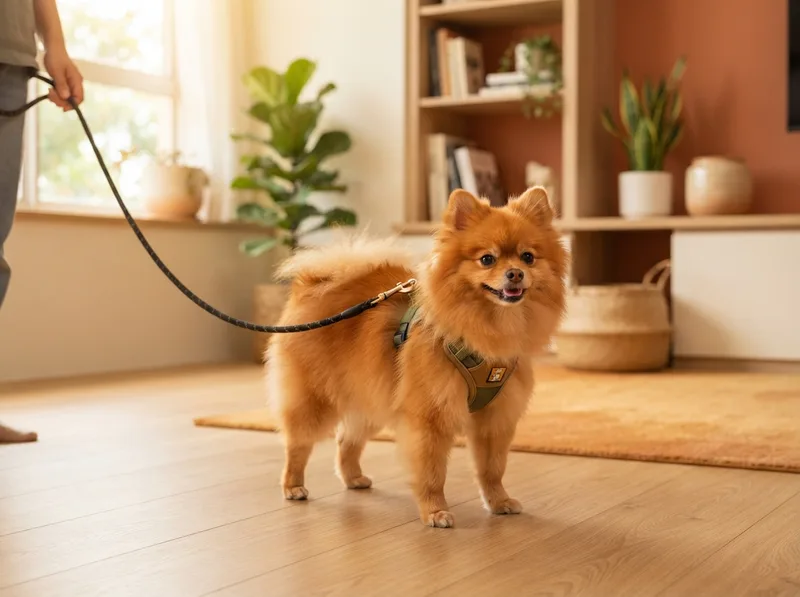
A harness, always, for walking. Pomeranians have a delicate windpipe and are prone to tracheal collapse, so pulling against a neck collar presses on exactly the wrong spot. A well-fitted harness spreads the force safely across the chest and shoulders. Keep a light collar only for the ID tag and AVS licence, and clip the lead to the harness.
Harness
For every walk
Chest
Where the force should sit
Collar
For the tag and licence only
2 fingers
The snug-fit test
Why the windpipe is the whole issue
Pomeranians, like many toy breeds, can be prone to tracheal collapse, a weakening of the rings that hold the windpipe open. You may also notice occasional reverse sneezing, a honking, snorting fit that is usually harmless but is a reminder of how sensitive that airway is. A neck collar concentrates every pull, lunge and excited lunge at the doorbell directly onto the throat, right where the trachea is most vulnerable.
A harness removes that pressure entirely by moving the connection point to the chest. This is not a fussy preference, it is the single clearest reason we tell every owner to walk on a harness. Our Pomeranian health guide covers tracheal collapse and the other small-breed conditions in more detail.
The airway, in brief
- Toy breeds are prone to tracheal collapse
- Reverse sneezing shows a sensitive airway
- A collar loads every pull onto the throat
- A harness moves force to the chest
- This is the top reason we say harness
So is a collar ever fine?
Yes, for one job: holding the identification tag and proof of the AVS licence. A light, comfortable collar that simply carries a tag sits loosely and takes no strain, so it is perfectly sensible. What you should not do is attach the lead to that collar and let your Pomeranian pull against it. The rule is simple: collar for the tag, harness for the walk. That way your dog is both properly identified and properly protected.
Choosing the right harness
Look for something light and well-padded that fits snugly without crushing the coat or rubbing behind the front legs. Many Pomeranian owners like a step-in or Y-front style, which keeps the straps clear of the throat and lets the shoulders move freely. Avoid anything bulky, stiff or heavy, and avoid harnesses that sit tightly across the windpipe at the front.
Because Poms carry a thick double coat, choose breathable materials and check the fit on the body, not just over the fluff. Sizes change as a puppy grows, so expect to size up once or twice in the first year and re-check the fit regularly.
What to look for
- Light, padded and breathable
- Step-in or Y-front keeps straps off the throat
- Free shoulder movement, no rubbing
- Fit checked on the body, not the fluff
- Re-size as your puppy grows
Fitting it right: the two-finger test
A harness only protects your Pomeranian if it fits. Aim for snug but not tight: you should be able to slide two fingers flat under each strap. Any looser and a startled Pom can back straight out of it, which is genuinely dangerous near a road. Any tighter and it rubs and restricts movement. Check the armpit area behind the front legs carefully, as that is where a poor fit chafes first.
Introduce the harness gently, the same way you would a crate: let your pup sniff it, reward calm, and pair putting it on with treats so it becomes a happy signal that a walk is coming.
Fit checklist
- Two fingers under each strap
- Snug enough that a startled Pom cannot slip out
- No chafing behind the front legs
- Re-check the fit as the coat changes
- Introduce it gently, paired with treats
Not sure which harness or lead suits a Pomeranian puppy? Ask us. Every pup we place also comes with a free first training lesson to start lead manners the right way.
Ask on WhatsAppLeash manners: a harness is not a licence to pull
A harness protects the windpipe, but it does not teach loose-lead walking on its own. A Pomeranian that has learned it can drag you around will simply do so more comfortably in a harness. Reward your Pom for walking with a loose lead, stop moving when it pulls, and reward again the moment the lead softens. Short, upbeat sessions suit the breed far better than long marches, and Singapore heat makes early-morning and after-dusk walks kinder anyway.
Pair the right kit with real training and you get a Pom that walks nicely and safely. Our guide to how to train a Pomeranian covers loose-lead work and the wider basics.
Walk nicely, walk safe
- A harness protects, it does not train
- Reward a loose lead, stop when it pulls
- Keep sessions short and upbeat
- Walk in the cool early morning or after dusk
- Combine good kit with real training
Do you still need a collar?
Yes, but only as a place to hang things. A flat collar carrying an identification tag and your dog licence tag is worth keeping on, because if your Pomeranian ever slips away from you the tag is what gets it home fastest. A microchip is permanent and a tag is instant, and in a lift lobby at 8pm instant matters more.
What the collar must never be is the attachment point. Clip the leash to the harness, every walk, no exceptions, and treat the collar as jewellery with a phone number on it. Keep it loose enough that two fingers slide under comfortably, and check that fit monthly, because a growing puppy outgrows a collar faster than you expect and a thick ruff hides a tightening one. If you would rather not run both, a harness with a tag ring is a reasonable compromise, provided the dog wears it indoors as well as out.
Collar rules
- Collar carries tags, never the leash
- Identification tag with a phone number
- AVS dog licence tag
- Two fingers under the collar, always
- Re-check fit monthly on a growing puppy
- Microchip is permanent, tags are instant
If your Pomeranian already honks or coughs
The sound people describe as honking is distinctive: a dry, repeated cough that sounds a little like a goose, usually triggered by excitement, pulling on a leash, drinking too fast, or a warm humid walk. It is the classic presentation of tracheal irritation, and in a toy breed it should not be filed under the dog has a tickle.
Switch to a harness immediately if you have not already, keep the dog lean because excess weight makes it worse, and avoid smoke, strong sprays and dusty environments at home. Then book a vet. Tracheal collapse is graded, most dogs are managed medically rather than surgically, and the earlier it is identified the more manageable it stays. What you should not do is assume that changing the equipment has solved it. Equipment stops you making it worse; it does not treat what is already there.
Frequently asked questions
Should a Pomeranian wear a harness or a collar?
A harness. Pomeranians have a delicate windpipe and are prone to tracheal collapse, so pulling against a neck collar puts pressure on exactly the wrong spot. A well-fitted harness spreads the force across the chest and shoulders instead. Keep a collar only for hanging the ID tag and licence, and walk on the harness.
Why are collars bad for Pomeranians?
A neck collar concentrates every tug and lunge onto the throat. In a small breed already prone to tracheal collapse and reverse sneezing, repeated pressure there can irritate or damage the windpipe over time. It is not about one gentle walk, it is the cumulative strain. A harness removes that risk by moving the pressure off the neck.
What type of harness is best for a Pomeranian?
A lightweight, well-padded harness that fits snugly without flattening the coat. Many owners prefer a step-in or a Y-front design that keeps straps off the throat and allows free shoulder movement. Avoid anything heavy or tight. The right fit lets you slip two fingers under each strap, with no rubbing behind the front legs.
Does my Pomeranian still need a collar and licence tag?
Yes. Every dog in Singapore needs an AVS licence, and an ID tag is sensible. Keep a light collar purely for the tag and licence, but clip the lead to the harness for walks. We complete the AVS licensing paperwork for you at purchase, so your Pomeranian goes home already licensed.
Meet your Pomeranian
Come say hello at Balestier
2 Balestier Road #01-701, Singapore 320002 · Weekdays 12pm–6pm · Weekends 10am–6pm. Or message us first: tell us about your home and routine, and we'll tell you honestly if a Pomeranian fits.
Know the health basics
Tracheal collapse is one of a few small-breed points worth understanding. Read the health guide.
Read the health guide